
Online Documentation with HR Software: Selection Criteria, Implementation & Practical Examples
HR software with a document management function enables companies to manage all personnel records—from employment contracts and onboarding packages to training certificates—securely, transparently, and accessibly at all times. But what key factors should you consider during the selection process to ensure a smooth integration while keeping costs transparent?
Key Takeaways
- A document management function enables secure, centralized, and legally compliant management of all HR-related records—from contracts to consent forms.
- Key factors when choosing software include GDPR data protection compliance, automation, e-signatures, employee self-service (ESS), and seamless integration into existing HR processes.
What is Online HR Documentation?
Online HR documentation refers to the centralized, digital management of all personnel-related files (the digital personnel file) within a secure cloud environment. It allows organizations to audit-proof store documents like contracts, references, and payslips, sign them digitally via e-signatures, and manage them efficiently through automated workflows.
3 Core Selection Criteria
- Hosting & Data Protection: Focus on GDPR-compliant EU hosting. Cloud solutions offer the necessary scalability and location-independent access while maintaining maximum security standards.
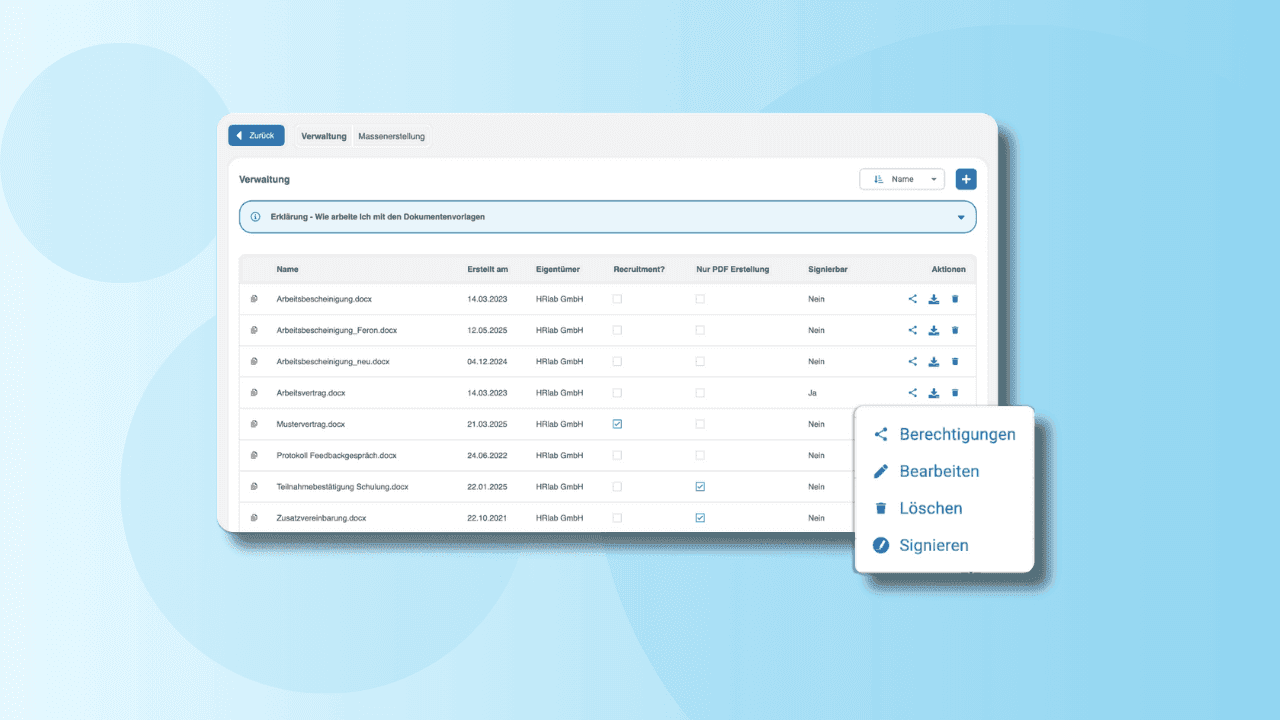
- Structured Document Management: Efficient document management systems (DMS) provide upload capabilities, version control, and granular role-based access controls to ensure sensitive employee data is accessible only to authorized personnel.
- Legally Binding E-Signatures: Integrated electronic signatures compliant with EU standards (eIDAS) accelerate contracting processes and eliminate media breaks.
6 Additional Critical Selection Factors
When selecting software for digital HR documentation, HR leaders should evaluate several core features to guarantee operational efficiency, security, and compliance.
Automation & Workflows
Modern systems support automated HR processes. Documents can be assigned automatically to employees, approvals and reminders integrated directly into workflows, and all process steps logged transparently. This saves HR teams valuable time and minimizes manual errors.
HR System Integrations
Ideally, digital HR documentation integrates seamlessly with other tools—such as onboarding modules, time and attendance tracking, or performance management solutions. Connecting to core enterprise IT software increases overall operational efficiency and reduces manual data entry.
Employee Self-Service (ESS)
An Employee Self-Service portal enables staff to independently view, download, or digitally sign documents. This relieves the administrative burden on the HR department while enhancing transparency and user experience.
Costs & Scalability
The selection process should account for the company's long-term requirements: user count, required storage capacity, and scalable licensing models. This ensures the solution remains suitable for small, medium, and large enterprises without incurring unexpected hidden fees.
Support & Localization
For organizations operating in German-speaking regions, local support is essential. The software must comply with current regional statutory and regulatory requirements, giving HR decision-makers complete peace of mind. German-language user interfaces and document templates are vital for local teams, while multi-language support benefits companies with international workforces.
Evaluating User Satisfaction
Beyond technical features and legal requirements, user satisfaction is critical. HR software delivers its full ROI only when adopted seamlessly by both HR teams and employees. Before implementation, examine peer reviews, case studies, or independent benchmark rankings such as the Professional User Rating 2027.
How HRlab Implements the Documentation Function
| Criterion | Implementation in HRlab |
|---|---|
| Hosting & Data Protection | GDPR-compliant hosting in the Germany, secure storage for sensitive HR data, and regular automated backups. |
| Document Management | Seamless document uploads, structured filing, and granular role-based access control. |
| E-Signatures & Digital Signing | Integrated e-signature feature for employment contracts, consent forms, and HR documentation compliant with EU standards (eIDAS). |
| Automation & Workflows | Automatic document assignment to employees, custom reminders, approval workflows, and full HR process integration. |
| Employee Self-Service (ESS) | Staff can view, download, and sign documents independently, significantly reducing HR administrative work. |
| HR System Integrations | Out-of-the-box interfaces for onboarding, time & attendance tracking, and performance management, plus custom IT integration options. |
| Costs & Scalability | Document management is included in the core HRlab package, scalable for small, mid-market, and enterprise businesses with a transparent pricing model. |
| Support & Localization | Comprehensive local customer support, fully compliant with German and regional HR labor laws and regulations. |
Advantages of HR Software with Document Management
To build efficient, secure, and future-proof HR operations, digital HR documentation is essential. Centralizing all employee records—from contracts and side agreements to training records and certifications—gives HR teams complete visibility and control.
Version control ensures that all changes are fully traceable and historical document versions remain accessible. At the same time, digital archiving guarantees audit-proof compliance with statutory retention requirements.
Another critical benefit is compliance enforcement: digital HR documentation simplifies adherence to GDPR guidelines and national labor laws. Granular permission management ensures only authorized roles view or edit sensitive employee files. Comprehensive audit trails log every activity—a vital asset during compliance audits and internal reviews.
Finally, digital solutions drive Employee Self-Service (ESS). Employees can view, upload, or sign documents electronically without involving HR at every step. This saves time, cuts administrative overhead, and improves overall employee satisfaction across the organization.
FAQ
Does every employee need individual login credentials for the HR software?
Yes. To unlock the full value of Employee Self-Service (ESS), individual user accounts are essential. This allows employees to access payslips in a GDPR-compliant manner, submit leave requests, or sign contracts digitally while reducing incoming HR support queries.
What does audit-proof archiving mean for HR documents?
Audit-proof archiving means documents are stored securely, completely, and in an unalterable format. Modern HR software ensures this through tamper-proof storage and audit trails (logging all access and modifications) in compliance with strict regulatory standards (e.g., GoBD).
How does the software streamline onboarding for new hires?
Through automated document workflows. New hires can sign contracts, complete employee questionnaires, and upload ID documents before their first day. This creates a smooth onboarding experience and ensures a "ready-to-work" start on Day One.