Selecting the Right Digital Time Tracking for SMEs: Legally Compliant & Flexible
Digital time tracking for small and medium-sized enterprises (SMEs) faces a clear mandate following the German Federal Labour Court (BAG) ruling and European jurisprudence: working hours must be recorded systematically, objectively, and reliably. For HR teams, this means parting ways with cluttered Excel spreadsheets and transitioning to a legally compliant, efficient digital time tracking system. This guide provides a sound decision-making framework to help you select the right solution for your company.
Key Takeaways
- Digital time tracking converts legal requirements into efficient, automated HR processes for SMEs.
- Systems capture working hours and break times in full GDPR compliance, down to the minute, and flexibly via terminals, web apps, or mobile devices.
- Automatic validation of overtime and rest periods reduces administrative overhead and protects against compliance risks.
- All-in-one solutions prevent isolated data silos and significantly simplify payroll preparation.
- A direct connection to payroll accounting minimizes transfer errors and saves valuable time during monthly closing.
What is Digital Time Tracking?
Digital time tracking is the software-supported recording, documentation, and processing of working hours and break times in real time. Instead of analog time cards or manual Excel spreadsheets, employees use time tracking systems to log their clock-in, clock-out, and break times digitally via an app, a browser, or a physical terminal. The data is stored centrally on cloud-based servers and synchronized directly with relevant HR systems.
This provides HR managers, team leads, and employees with transparent, real-time insights into working time accounts, overtime, and vacation entitlements at any time. Beyond pure time recording, a dedicated system ensures automatic compliance with labor law requirements and streamlined, direct payroll preparation.
Core Functions at a Glance
- Legally Compliant Time Tracking: Built-in software compliance with break times and maximum working hours under the Working Hours Act (ArbZG in Germany).
- Flexible Recording Channels: At the office PC, on the go via mobile app, or via physical terminal.
- Project & Activity Tracking: Assignment of working hours to specific clients, projects, or cost centers for precise controlling.
- Automatic Rule Execution: Configuration of custom working time models with automatic calculation of surcharges within the working time account.
- Integrated Payroll Preparation: Seamless transfer of adjustment and overtime data to DATEV & co.
Example: Advantages of Digital Time Tracking for HR Teams
| Criterion | Effort of Manual/Analog Solutions (Excel/Paper) | Digital Time Tracking with HRlab |
|---|---|---|
| Recording Effort | High manual effort due to hand-written entries, illegible time cards, or cluttered Excel files. | Employees record time flexibly via start-stop functionality in the dashboard, directly in the web browser, or via the smartphone app. |
| Approval & Control | Cumbersome, decentralized tracking; corrections and approvals must be requested via email or paper slips. | Approving roles review and release open time entries at a glance within the time tracking overview. |
| Employee Transparency | High support burden on HR due to constant inquiries regarding overtime, breaks, and remaining vacation. | Employees have live visibility into their own profile regarding overtime accounts, vacation entitlements, and logged hours. |
| Break Calculation | Tedious manual checks with high error liability when verifying statutory rest periods and break times. | HR can centrally control how breaks are automatically calculated and evaluated via the working time account model. |
| Payroll Preparation | Time-consuming manual extraction, consolidation, and transfer of hour logs into payroll before month-end. | Automated export and direct interfaces to payroll accounting (e.g., DATEV) for error-free data transfer. |
| Scalability | Requires disproportionately high HR resources as the company grows, quickly causing administrative bottlenecks. | Scales flexibly with the business and processes increasing employee counts without added administrative overhead. |
Choosing the Right Approach: All-in-One Software vs. Point Solution?
When transitioning, SMEs often face the choice between specialized point solutions (best-of-breed) and integrated overall HR platforms (all-in-one).
While a standalone time tracking app can be deployed quickly for a single use case, it often creates duplicate data management and interface bottlenecks in daily operations. Updates to master data, sick leave notices, or vacation requests must be manually synchronized across multiple tools. An all-in-one platform like HRlab embeds time tracking directly into the existing HR ecosystem. Working hours flow automatically into absence management, overtime accounts, and payroll preparation. For SMEs, this delivers maximum data continuity and drastically reduced IT maintenance effort.
Classification in the HR Ecosystem
| HR Area | Main Function | Relevance of Time Tracking for this Area |
|---|---|---|
| Personnel Management | Digital Personnel File | Centralized, GDPR-compliant storage of all contract data, supplementary agreements, and working time models relevant to working hours. |
| Time Management | Absence Management | Automatic alignment of target hours with vacation, sick leave, parental leave, and special leave for accurate time accounts. |
| HR Processes | Approval Workflows | Efficient, multi-level approval of overtime, correction requests, or compensatory time off directly by managers. |
| Payroll | Payroll Interface | Seamless, error-free transfer of all worked hours, overtime, surcharges, and absences to DATEV & co. |
| People Development | Talent Management | Transparent analysis of capacity utilization and project hours to identify workload spikes and resource needs early. |
Checklist for Implementation in the Company
- Define Requirements: Determine which recording channels and working time models are needed across operations.
- Involve the Works Council: Coordinate co-determination rights early when introducing technical monitoring equipment.
- Verify Data Protection: Clarify access permissions in advance—defining who can view, edit, and create data (role and permission concept).
- Clarify Interfaces: Ensure data can be passed smoothly to your payroll software (e.g., DATEV).
- Change Management: Communicate the benefits and added transparency clearly to the workforce.
Legally Compliant Time Tracking: Statutory Requirements
Following the German landmark BAG ruling, systematic daily working time tracking is mandatory for German companies. For SMEs, this creates specific legal parameters:
- Working Hours Act (ArbZG): Obligation to seamlessly record daily working hours, adhere to maximum daily hours, and observe statutory rest breaks and periods.
- GDPR & Data Protection: Logged times constitute personal data. Strict requirements apply to access rights, anonymization, and data security.
- GoBD Compliance: Systems must guarantee that time entries remain immutable and complete. Retrospective adjustments must be logged auditably.
- Retention Periods: Working time records must be stored securely in accordance with legal guidelines and kept ready for audits.
How HRlab Solves Digital Time Tracking
HRlab delivers a flexible time tracking system tailored to the operational realities of SMEs—whether your teams work in the office, hybrid, or directly on-site.
HRlab Snapshot: Time Tracking
| Category | Features & Functionality in HRlab |
|---|---|
| Target Group | Mid-sized companies (50 to 2,000 employees) with hybrid or decentralized teams. |
| Recording Methods | Employees can record hours conveniently via mobile app, desktop, or physical terminals. |
| Integrations | Seamless connection to digital personnel files, absence management, shift planning, and payroll (DATEV & others). |
| Compliance & Legal Security | Automatic validation of rest periods (ArbZG), overtime limits, GoBD, and GDPR compliance. |
| What HRlab Does Exceptionally Well | Geofencing, project time tracking, offline capabilities—and simple integration of hours from third-party systems via API. |
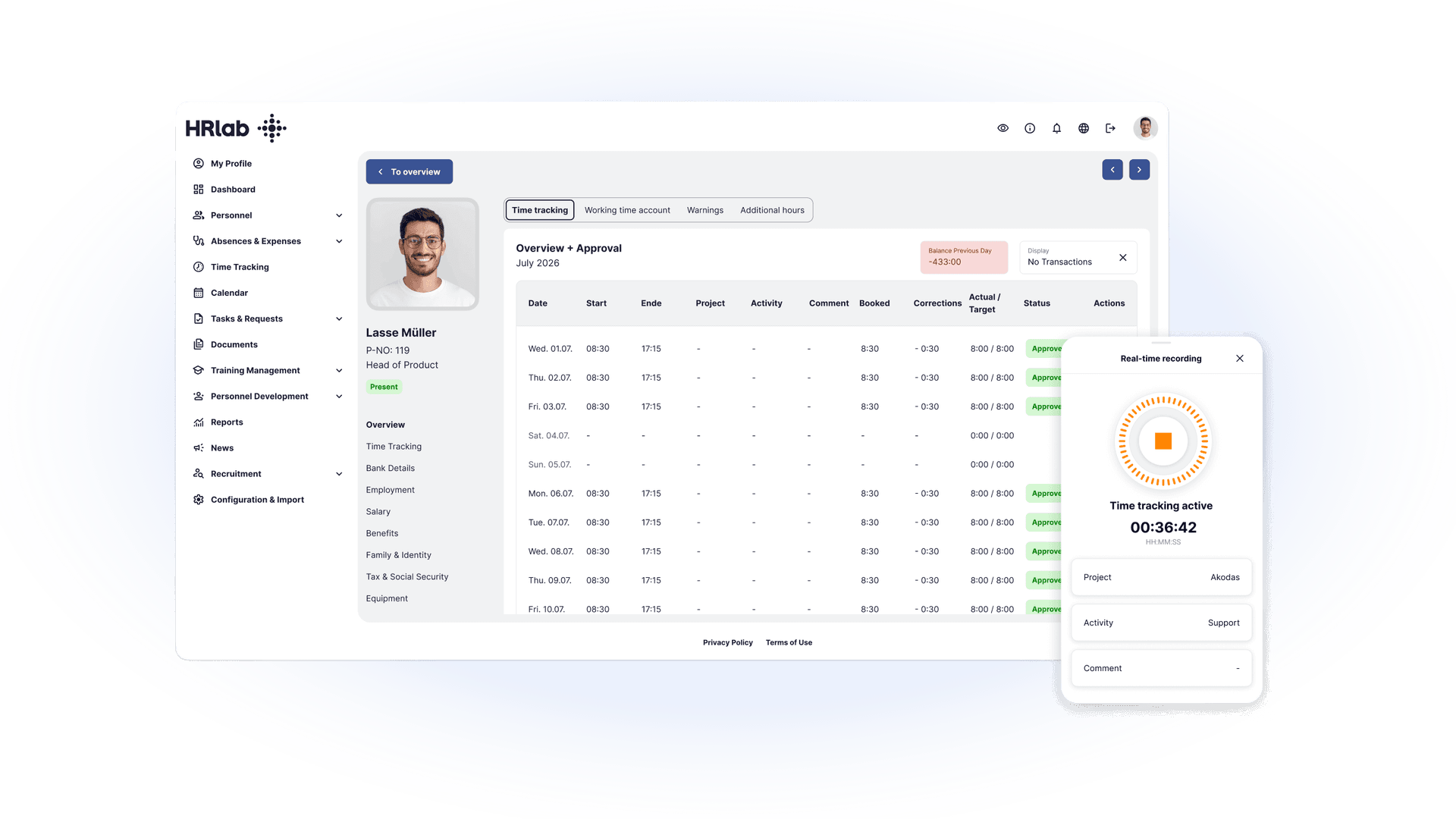
Before implementing HRlab, adjustment slips for time tracking used to pile up on my desk regularly. That has now changed dramatically, as our time tracking currently runs fully automated and reliably.
FAQ
Which HR software offers digital time tracking?
An all-in-one HR platform like HRlab offers integrated digital time tracking connected directly to absence management, digital personnel files, and payroll preparation. Employees can capture working and project hours via mobile app (iOS/Android), web browser, or physical terminals. Built-in compliance rules (BAG- and EuGH-compliant) and native DATEV interfaces allow validated data to flow automatically into payroll.
Why is HRlab particularly suitable for SMEs?
HRlab is tailored to mid-sized businesses (approx. 20 to 500+ employees) because it consolidates core HR processes into a single all-in-one platform without data silos. It handles complex working time models, offers automatic rules for overtime and surcharges, reduces manual payroll effort by up to 80%, and guarantees 100% legal compliance with German server hosting.
Is digital time tracking mandatory for SMEs?
Yes, under the BAG ruling and EU regulations, employers in Germany are obligated to implement an objective, reliable, and accessible system to record employees' daily working hours. Pure trust-based working hours without any time documentation are no longer legally compliant.