
Working Time Accounts: Models in Comparison & Case Study
Working time accounts (time banks) rarely fail because of the model chosen—they fail during operational execution. In practice, unclear rules regarding negative balances, absences, or settlement deadlines quickly lead to disputes. By establishing clearly defined, legally compliant guidelines and involving the works council, a working time account becomes an effective HR instrument that enables workforce flexibility while building trust.
Key Takeaways
- A working time account tracks and manages accrued overtime and undertime flexibly.
- Rules for settlement and utilization vary depending on the model—such as flexitime, traffic light, annual, or long-term accounts.
- Tracking is usually performed digitally, with balances needing regular settlement or financial safeguarding.
- Clear policies, transparency, and thorough documentation protect against disputes and the loss of accumulated time credits.
What Is a Working Time Account and How Does It Work?
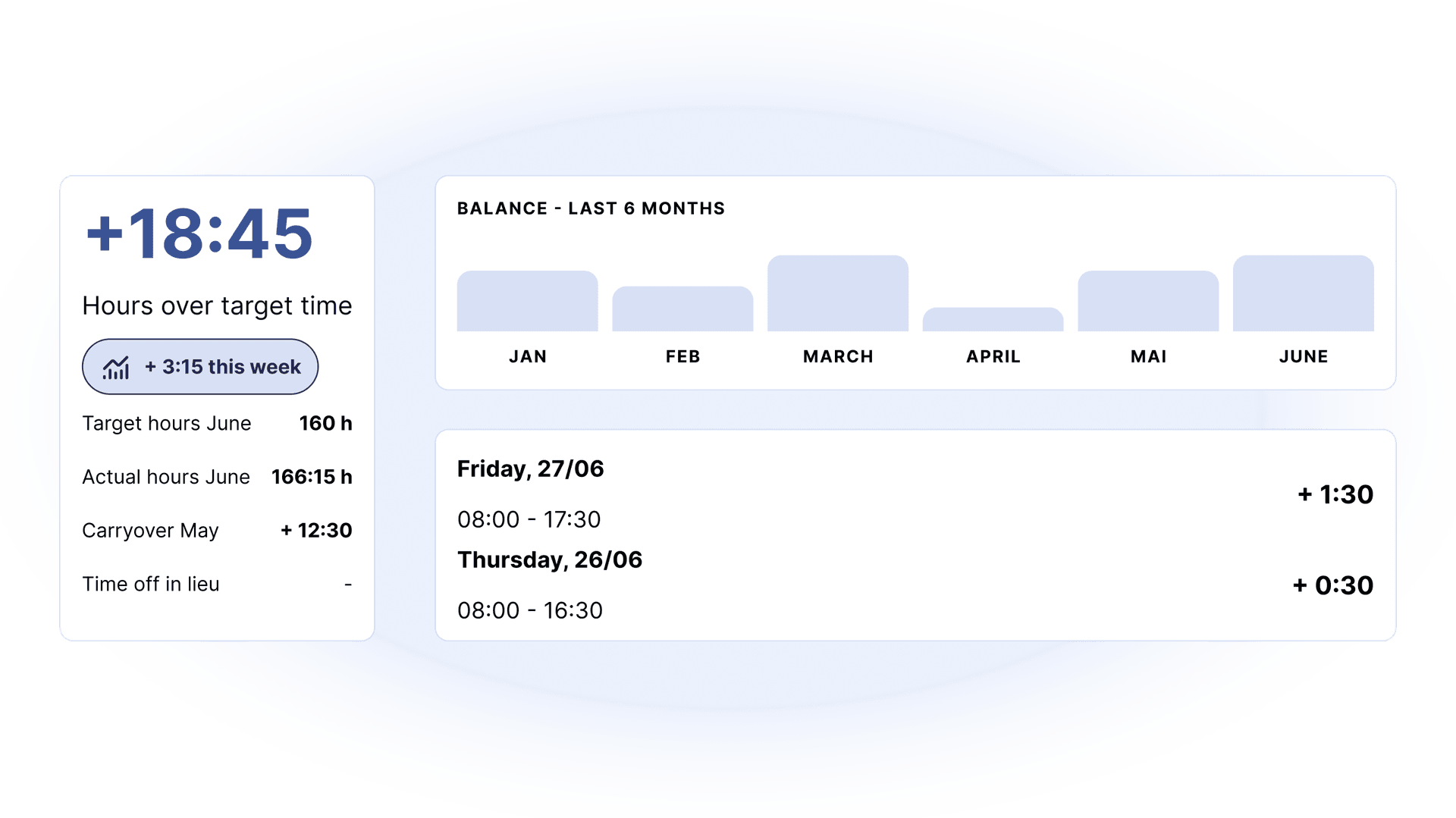
A working time account (also referred to as a time bank or hours account) records the difference between an employee's contractually agreed target hours and their actual hours worked:
- Positive balance (Overtime / Time credits): Accrues when employees work longer than contractually agreed.
- Negative balance (Undertime / Time debt): Accrues when actual working hours fall below target hours.
How Practical Calculation Works
Time tracking today is primarily managed digitally via mobile apps, terminals, or software. The system continuously reconciles actual hours worked against stored target hours—taking into account part-time quotas, shift schedules, and mandatory break periods.
Absences such as vacation leave, statutory public holidays, and sick leave feed directly into the running balance. Once a balance reaches defined thresholds, predetermined settlement mechanisms take effect—such as time off in lieu (TOIL), payouts, or balance resets over designated settlement periods.
How Does a Digital Working Time Account Work in Detail?
Working hours are typically tracked digitally using automated time tracking systems, time clocks, or mobile apps. This forms the core of the working time account.
Behind the scenes, automated calculations run continuously: actual hours minus target hours yields the current balance. If this balance strays above or below configured limits, predefined rules trigger automatically—enforcing time off in lieu, initiating payout workflows, or adjusting balance periods.
Key Working Time Account Functions for HR
- Legal Safety & Compliance: Automatic verification of breaks, rest periods, and maximum daily/weekly working hour limits in compliance with statutory labor laws (e.g., Working Time Act / ArbZG).
- Self-Service (ESS/MSS): Digital workflows for time adjustment requests, leave requests, and real-time balance tracking for employees and managers.
- Traffic Light System: Visual overtime management and proactive threshold alerts.
- Payroll Integration: Seamless payroll software interfaces for automated transfer of overtime bonuses and shift allowances.
- Reporting & Analytics: Instant reporting on workforce capacity, absenteeism, and financial accruals for balance sheet provisions.
Legal Requirements & Insolvency Protection
In accordance with rulings by the European Court of Justice (ECJ) and the German Federal Labour Court (BAG), employers in Germany are obligated to record daily working hours systematically, objectively, and comprehensively. This obligation stems from the Occupational Safety and Health Act (ArbSchG) as well as § 16 ArbZG and applies without exception to flexible working arrangements such as flexitime, annual hours, or long-term accounts.
Key Legal Considerations for HR:
- Documentation Duty: The start, end, and total duration of daily working hours must be recorded in an audit-proof and tamper-resistant manner.
- Right of Inspection: Employees have the right to access a transparent overview of their current working time account balance at any time.
- Automation: Modern software interfaces allow time tracking to connect directly to payroll accounting, ensuring full compliance during regulatory labor inspections.
Insolvency Protection: Safeguarding Accrued Time Credits
Accrued time credits represent actual monetary value but are not automatically protected. If a company enters insolvency or dissolves, employees risk losing their accumulated overtime hours.
To protect time balances in a legally compliant manner, HR departments can utilize the following mechanisms:
- Statutory Requirement for Long-Term Accounts: § 7b SGB IV mandates that accrued value balances on long-term or lifetime working time accounts must be secured against insolvency.
- Trust Models & Financial Provisions: Transferring value balances into insolvency-proof Contractual Trust Arrangements (CTA) or setting up corresponding balance sheet provisions.
- Insurance Solutions: Utilizing specialized coverage models (e.g., R+V working time account protection) to hedge against insolvency risks.
Implementing Digital & Legally Compliant Time Accounts with HR Software
Working time accounts can only be managed reliably when time tracking, the working time account model, and payroll accounting (e.g., DATEV-compatible time tracking) operate in seamlessly integrated workflows. This is precisely where digital HR systems like HRlab step in: they create a centralized, automated foundation for managing working hours and time account balances.
Case Study: How a Corporate Group with 80 Employees Eliminated Paper-Based Chaos
Background & Challenge:
A rapidly growing corporate group in the two-wheeler sector (motorcycle and bicycle retail, repair workshops, gastronomy, and a motel with approximately 80 employees) faced the challenge of manually managing working time accounts and timesheets.
- Problem: Working hours were recorded on traditional paper timesheets based on trust, supplemented by chaotic Excel spreadsheets and physical binders.
- Risk: High error rates, lack of visibility regarding vacation and sick leave, and immense pressure to meet statutory time-tracking obligations in a timely and legally compliant manner.
- Industry Hurdle: During the peak motorcycle season, there was zero time available for a multi-month software implementation.
- The Solution with a Digital Working Time Account (HRlab):
The company transitioned all working time accounts to HRlab’s digital HR software in just 2 weeks—right on schedule before the seasonal peak began.
The Results for HR and Employees:
- Transparent Balances: Paper timesheets were completely replaced by digital time tracking. Overtime and undertime balances on working time accounts are accessible at any time via Employee Self-Service (ESS) for both employees and HR.
- Error-Free Absence Management: Leave requests and sick leave notifications flow automatically into target vs. actual working hour calculations.
- Automated HR Workflows: Automated notifications (e.g., regarding continued remuneration after 6 weeks of illness) significantly relieve the workload on the HR department.
Manage Working Time Accounts Effortlessly with HRlab
HRlab supports all common working time account models. Custom target hours, overtime bonuses, mandatory break adjustments, and special provisions are calculated automatically. Furthermore, custom approval workflows can be configured individually with just a few clicks.
The 6 Most Important Working Time Account Models in Comparison
The choice of the right model depends on the industry, company size, and flexibility requirements. The following table serves as a decision-making guide for HR managers, followed by a detailed breakdown of each model:
| Model | Focus / Objective | Typical Settlement Period | Special Considerations (Legal & Practical) |
|---|---|---|---|
| Flexitime Account (Gleitzeit) | Daily working hours flexibility | Monthly to annually | Observe core working hours; ideal for work-life balance. |
| Short-Term Account (Kurzzeitkonto) | Offsetting peak workloads | Weeks to months | Frequently used in seasonal businesses or during short-time work (Kurzarbeit). |
| Traffic Light Account (Ampelkonto) | Overload & burnout prevention | Ongoing (system-automated) | Automated warning thresholds (Green/Yellow/Red) for risk management. |
| Annualized Hours Account (Jahresarbeitszeit) | Income stabilization | 12 months | Ideal for retail; fully absorbs seasonal fluctuations. |
| Long-Term Account (Langzeitkonto) | Life-stage-oriented planning | Multiple years / decades | Mandatory insolvency protection under § 7b SGB IV; used for sabbaticals or early retirement. |
| Trust-Based Working Time (Vertrauensarbeitszeit) | Result-oriented work | Individual / Flexible | Key note: Mandatory statutory tracking applies despite trust-based culture (BAG ruling). |
Short-Term Account ("Kurzzeitkonto" in German)
A short-term account is designed to buffer short-term operational fluctuations. When a company experiences a spike in workload over a few weeks or months, overtime can be accumulated on the account. During quieter periods, these hours are subsequently reduced. This model is frequently utilized during short-time work (Kurzarbeit) or in seasonal businesses. It helps absorb peak workloads or temporary lulls in demand flexibly without forcing immediate overtime payouts or staff layoffs.
Annualized Hours Account ("Jahresarbeitszeitkonto" in German)
An annualized hours account assesses working time over an entire twelve-month period rather than on a monthly basis. Contracted working hours are distributed across the full year. Employees who work longer hours during peak seasons can work fewer hours in slower periods without immediate consequences. This model is particularly beneficial for part-time workers or marginal employees (Minijobber), as it allows flexible adjustments to actual workload demands. Companies in retail, manufacturing, and service industries also leverage annualized hours accounts to adapt schedules to seasonal fluctuations.
Long-Term Account / Lifetime Working Account ("Langzeitkonto / Lebensarbeitszeitkonto" in German)
A long-term account—often referred to as a lifetime working account—is structured over many years. Employees gradually save up a time credit balance that can later be used for extended leaves. Common real-world applications include sabbaticals, family caregiving leave, or early transition into retirement. The legal framework for these accounts in Germany is established in § 7b SGB IV and the Flexi II Act, which strictly regulate how such value balances must be secured.
A critical requirement here is insolvency protection to ensure accrued hours are not lost if the employer faces bankruptcy. This is typically achieved through Contractual Trust Arrangements (CTA) or insurance models. A specific variation of the long-term account is phased retirement (Altersteilzeit), which allows employees to reduce their working hours in the years leading up to retirement while continuing to receive a salary.
Flexitime Account ("Gleitzeitkonto" in German)
A flexitime account is among the most widely recognized and popular models. Employees can independently determine the start and end of their daily working hours within defined boundaries. Actual hours worked are logged to the account, accumulating positive or negative balances. However, these balances must be settled within a predetermined reference period.
A key distinction from standard overtime is that flexitime hours accumulate systematically according to schedule and are not automatically compensated with extra pay. The model benefits both parties: employees gain greater schedule flexibility and an improved work-life balance, while employers can align working hours with customer demand. Clear parameters must be established, such as maximum allowable balance caps or procedures for illness and employee departures.
Trust-Based Working Time with a Time Account ("Vertrauensarbeitszeit" in German)
Trust-based working time gives employees substantial autonomy in managing their working schedules. Nevertheless, a working time account is still maintained to document actual hours worked. This creates transparency for both sides: employees exercise operational flexibility while employers ensure compliance with statutory working time limits. This model is primarily used in roles less tied to fixed schedules, such as project-based work or output-driven roles.
Traffic Light Account ("Ampelkonto / Ampelmodell" in German)
The traffic light account—often called the traffic light model—categorizes the working time balance into three distinct zones. As long as accumulated hours remain in the green zone, no intervention is required. Transitioning into the yellow zone serves as a warning threshold where additional overtime typically requires manager approval. The red zone signals that maximum load limits have been reached and balance reduction is mandatory. This structure prevents employee burnout and ensures fair workload management. It is widely adopted in healthcare and shift-based operations with high schedule volatility.
Working Time Accounts for Part-Time & Marginal Employees ("Minijob" in German)
Working time accounts can also be implemented for part-time workers and marginal employees (Minijobber). For marginal employees, it is critical that monthly earnings thresholds are not exceeded. Overtime in Minijobs is therefore typically compensated through time off in lieu rather than direct cash payouts. German Minijob-Zentrale authorities explicitly confirm that marginal employees may maintain a time bank if contractually agreed. Upon termination of employment or at year-end, remaining accrued hours may be paid out if time off is no longer feasible.
Part-time employees also benefit from time accounts. However, it is crucial that they are not disadvantaged during sick leave or statutory public holidays. Target hours must always be calculated correctly to prevent unwarranted negative balances. Clear agreements avoid disputes and ensure part-time staff have equal access to workplace flexibility.
Working Time Accounts in Temporary Agency Work ("Zeitarbeit" in German)
In temporary agency work, working time accounts are a standard management tool. Positive balances accumulated during client assignments can be drawn down during assignment-free periods. This secures continuous employment and regular compensation for agency workers even during temporary lulls in assignments. However, frictions frequently arise, particularly when employment terminates or prolonged assignment gaps occur. Clear policies regarding balance management and settlement are essential for operational predictability.
Time Accounts in Payroll: Key Terms & Concepts
A poorly managed or incorrectly tracked working time account introduces legal, tax, and financial exposure for both employers and employees. HR departments must ensure the following practices:
- Unique booking codes and transparent line items on pay slips
- Regular auditing of time account balances
- Traceable, audit-proof documentation of all time balances
- Clear works council agreements covering settlement, payout rules, and expiration conditions
- On pay slips and payroll statements, values related to working time accounts commonly appear under terms such as: