
Workforce Age Structure Analysis: Methods & Software
A workforce age structure analysis in human resources is the systematic collection, preparation, and evaluation of the age distribution of all employees within a workforce as of a specific key date. Especially for small and medium-sized enterprises (SMEs), this instrument is gaining immense importance in the course of demographic change. When high-birth-rate cohorts ("baby boomers") retire en masse from working life, workforces without structured succession planning face critical bottlenecks.
Key Facts
- Strategic workforce planning tool designed to analyze the age-related structure of a company's workforce.
- Enables the early identification of demographic gaps and impending waves of retirement.
- Protects against unwanted loss of knowledge transfer and increases succession security for mid-sized businesses.
- Utilizes core HR metrics such as average age, age quotient, and replacement ratio.
- GDPR-compliant implementation requires anonymized group evaluations above defined team thresholds.
What is a workforce age structure analysis in HR?
A workforce age structure analysis is a method of quantitative HR controlling. It determines the current state of age distribution within an organization and sets it in relation to strategic goals as well as future business development. The goal is to derive actionable recommendations from age data for recruiting, personnel development, knowledge transfer, and occupational health management (OHM).
2026 Study Highlights the Relevance of Age Structure Analysis
Many companies plan their revenues and capacities years in advance, yet neglect the demographic development of their own workforce. Lacking a forward-looking analysis leads abruptly to unfillable key positions.
An HRlab study from 2026 illustrates the extent of the problem:
- Nationwide, approximately 4.2 million employees aged 60 and older face only around 2.6 million young professionals aged 20 to 25.
- In numerous districts and regions—particularly in parts of Brandenburg or Saxony-Anhalt—up to 200 or more potential retirees correspond to every 100 young entrants into the workforce.
In addition, there is a shift in workforce behavior: Current labor market studies show that up to 44 percent of employees are considering early retirement before the statutory retirement age. A reliable workforce age structure analysis uncovers such hidden risks and prevents valuable institutional knowledge from leaving the company unexpectedly.
Key Metrics and their Meaning
| Metric | Formula / Definition | HR Value |
|---|---|---|
| Average Age | Total sum of years lived divided by the total number of employees | Initial baseline value; however, it distorts extreme values and age clustering. |
| Median Age | The exact age that splits the entire workforce into two equal halves | More resilient against outliers than the average; shows the actual center of distribution. |
| Replacement Ratio | Number of employees aged 60+ divided by the number of employees aged 20 to 25 | Shows the direct relationship between potential retirees and available junior talent. |
| HR Age Quotient | Number of employees aged 55+ divided by employees aged 15 to 54, multiplied by 100 | Measures the proportion of senior team members relative to employees further from retirement. |
| Retention & Exit Rate | Percentage share of projected retirements per calendar year | Enables precise temporal planning for succession hires and handover phases. |
Methodology & Execution in 3 Steps
In traditional HR work, an age structure analysis requires manual and time-consuming preparation. However, if you use HR software, for example, a large portion of manual work steps is eliminated, as master data, birth dates, and organizational structures are already managed centrally. HR systems like HRlab generate corresponding reports fully automatically in real time.
-
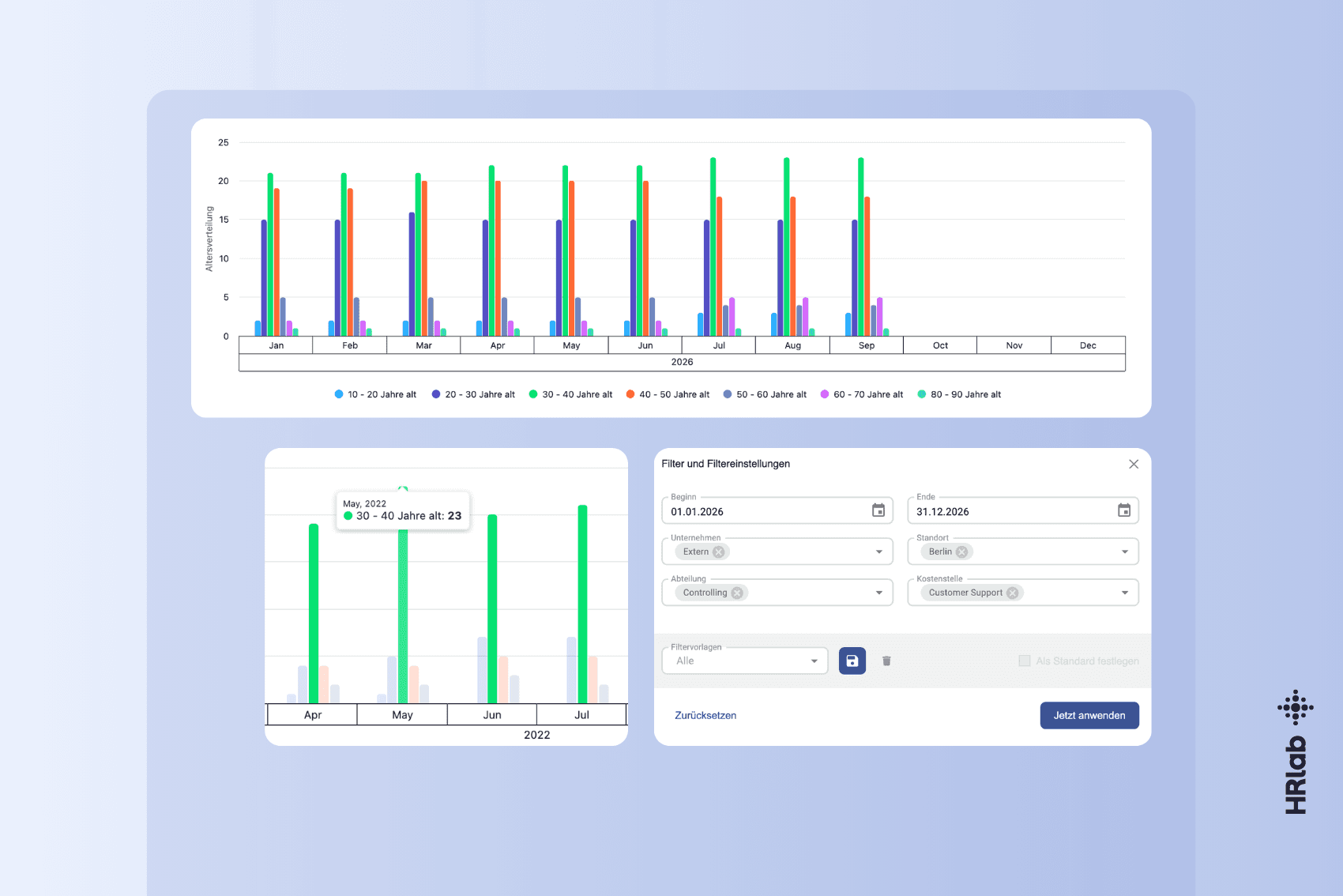
1. Data Collection & Segmentation: With manual approaches, birth dates must first be gathered and consolidated. An integrated HR software handles this step automatically in the background. You can immediately filter data by company, location, department, or cost center and even create custom filter templates. This allows you to segment without manual effort.
-
2. Visualization (Distribution Curves): Instead of manually building distribution curves in spreadsheets, HR software generates the graphical representation directly. You can see at a glance whether your structure resembles a pyramid (balanced junior talent), a mushroom shape (overaging with high clustering risk), or an urn shape (very few young employees).
-
3. Derivation of Actionable Measures: Because time spent on data collection and preparation is eliminated, you can direct your resources directly toward strategic measures. Develop targeted recruiting strategies, set up personnel development programs, and establish intergenerational tandems.
Key Points HR Must Keep in Mind During Implementation
When gathering and processing age data, HR managers must strictly comply with legal regulations:
- General Data Protection Regulation (GDPR): A birth date constitutes personal data. Processing it is permissible for executing the employment relationship (including strategic workforce planning), but requires adherence to the principle of data minimization.
- Anonymization & Group Thresholds: To avoid conclusions about specific individuals, evaluations and reports for executive management or works councils should solely be presented in aggregated form (e.g., in 10-year age brackets as in HRlab) and with a minimum group size of at least 5 people.
- Works Constitution Act (BetrVG): Pursuant to Section 92 BetrVG, the works council must be informed in a timely and comprehensive manner regarding workforce planning—which includes analyzing the age structure. Under Section 95 BetrVG, selection guidelines for transfers or succession planning require works council approval.
- General Equal Treatment Act: Measures derived from results must not lead to unlawful discrimination based on age (Section 1 AGG). Job postings or internal development programs must be phrased in an age-neutral manner.
FAQ
Which software solutions offer workforce age structure analysis?
HR software systems such as HRlab, for example, offer integrated modules to automate workforce age structure analysis. The practical advantage: such a system draws directly from centralized employee master data and generates reports fully automatically in real time. This eliminates the manual burden of data exports and complex spreadsheet creation.
How often should an organization evaluate its workforce age distribution?
Continuous, real-time tracking via automated HR dashboards is optimal. For manual workflows, an annual review aligned with strategic workforce and budget planning is strongly recommended. Organizations in high-growth phases or industries facing severe demographic pressure (such as manufacturing, healthcare, or public services) should conduct quarterly assessments.
How is GDPR compliance ensured during an age structure analysis?
An employee's birth date constitutes personal data under Section 26 BDSG and the GDPR. To ensure compliance, reports shared with management or works councils must only display aggregated data—such as 10-year age brackets. Furthermore, a threshold of at least 5 employees per evaluation segment must be enforced to prevent identification of specific individuals.