
Talent Management Software: Features, Benefits and How to Choose
To make people development work, companies need connected processes that bring performance reviews, goal setting, feedback and training together in one place. Talent management software provides the operational foundation for this, helping you make HR decisions in a planned, transparent and data-driven way. Here are the key features and tips for choosing the right system.
Key takeaways
- Talent management software replaces manually maintained Excel lists and PDF records with a single, end-to-end digital process.
- Core features include performance reviews, goal setting, 360-degree feedback, and training and skills management.
- Integrated HR suites connect talent management with the digital employee file, workflows and reporting. Specialist tools cover individual areas in more depth.
- When choosing a system, look at functionality, integration, data protection and hosting, permissions and visibility settings, and how well managers accept it.
- When a company introduces this kind of software in Germany, the works council (Betriebsrat) has co-determination rights.
What is talent management software?
Talent management software (also called an HR talent management system or talent management platform) helps HR and managers develop employees in a targeted way and retain them over the long term. Instead of scattered documents, you get a continuous cycle: hold reviews, agree goals, gather feedback, plan development activities and measure progress.
The term is used in a broader and a narrower sense:
- In the broader sense, talent management covers the entire employee lifecycle, including recruiting and onboarding.
- In the narrower sense, talent management starts after hiring and focuses on development, performance and retention. This view is common among mid-sized companies and largely matches traditional people development.
How it differs from related systems
| System | Focus | Relationship to talent management software |
|---|---|---|
| HR software / HRIS | HR administration, master data, employee file, absences | Talent management is often a module within the HR suite and uses its master data |
| Learning management system (LMS) | Delivering e-learning content and courses | Talent management software plans and documents training; an LMS provides the learning content |
| Applicant tracking | Job postings, candidate selection | Only part of talent management in the broader sense |
| Performance management tool | Goals, OKRs, feedback | Covers one part of talent management in a specialised way |
Core features of talent management software
Most systems cover five areas, which only deliver their full value when they work together.
Performance reviews
In the feedback system, HR sets up review types such as annual reviews, feedback conversations or probation reviews, each with a fixed template. Managers receive reminders about upcoming dates, and results are recorded centrally and confirmed by both sides.
Goal setting
Goals are recorded with a time frame, weighting and metric, and tracked continuously. This shows at any time whether a goal is on track or at risk. Learn more: Goal setting software.
360-degree feedback
A 360-degree feedback process gathers input from managers, colleagues, direct reports and, where relevant, customers. Software such as HRlab offers visibility settings that help ensure honest answers.
Training and development management
Results from reviews and feedback turn into concrete development activities, such as a language course or a certification. Integrated employee training software plans, approves and documents them in the training history. Learn more: Training management software.
Skills and competency management
As part of [skills management](Skill Management Software), competencies and qualifications are recorded and compared against the requirements of a role. Gaps between target and actual skills show where training will have the biggest impact. Some providers also offer succession planning, career paths or engagement surveys. These modules are mainly worthwhile for larger organisations with defined career frameworks.
Benefits: Excel and paper vs. software
The biggest gain doesn’t come from individual features, but from keeping reviews, goals and development activities connected. The table shows the difference using HRlab as an example.
| Criterion | Excel, Word and paper | Talent management software (e.g. HRlab) |
|---|---|---|
| Review preparation | Every manager uses their own forms; documents are scattered | HR stores templates for each review type; teams can select the right form |
| Dates and deadlines | HR sends manual email reminders; reviews get postponed | Automatic reminders for managers and employees |
| Goal tracking | Goals disappear into PDFs; progress remains unclear | Progress, weighting and status are visible at all times |
| Feedback | Individual comments without a consistent scale | Structured questionnaires with scales and free text, ready for analysis |
| Training | Training records kept in folders or spreadsheets | Development activities and training history for each employee |
| Documentation | Records stored in inboxes and on shared drives | Stored in the digital employee file |
| Analysis | Time-consuming consolidation before every talent review | Reports at the click of a button, e.g. by team or location |
For employees, this means more transparency about goals and development opportunities. Managers save time on preparation, and HR gets comparable data for development decisions for the first time.
HR suite or specialist tool, SaaS or on-premise?
For most mid-sized companies, a cloud-based HR suite with a talent management module is the obvious choice. A specialist tool is mainly worthwhile if you need to cover a single area, such as performance management, in great depth.
| Criterion | HR suite with talent module | Specialist tool |
|---|---|---|
| Master data | Taken directly from the employee file | Must be synchronised via interfaces |
| Depth of functionality | Broad, with all areas connected | Very deep in one area |
| Implementation | One system, one point of contact (depending on the provider’s support) | Possibly an additional system alongside existing tools, plus extra training |
| Data protection | One permissions concept for all HR data | Additional data processing agreement and permissions concept |
Talent management as SaaS
Most systems today are run as software-as-a-service (SaaS): the provider hosts the software, updates are applied automatically, and users access it via browser or app. On-premise solutions running on your own servers mainly matter for large corporations with specific IT requirements. With SaaS, companies should check the server location and cloud sovereignty, the data centre’s certification, and whether a data processing agreement is in place.
Where it fits in the HR ecosystem
As shown above, a talent management solution only becomes truly effective when it can access your other HR data. These areas are the most closely connected:
| HR area | Main function | Link to talent management |
|---|---|---|
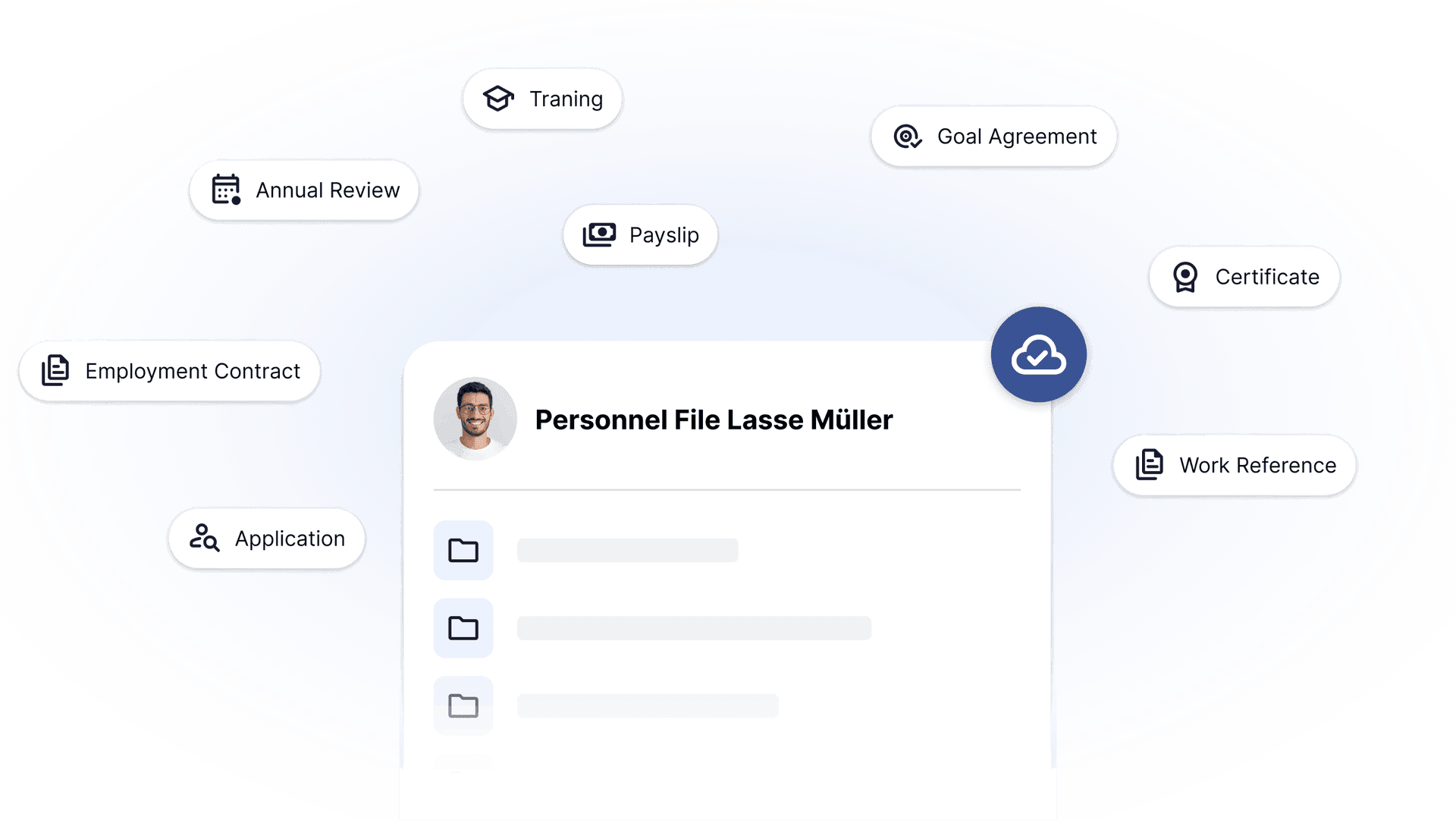
| HR management | Digital employee file | Review records, goal agreements and certificates are stored centrally with each employee |
| HR processes | Approval workflows | Training requests and development activities are approved directly by managers |
| Time management | Time tracking and absences | Training days feed into working time accounts and absence planning |
| Payroll | Payroll interface | Salary adjustments agreed in reviews are passed on to payroll |
| Reporting | Analytics | Development status, goal achievement and training rate across teams and locations |
What to look for when choosing a system
If you’re looking for talent management software, clarify your own processes first and only then compare providers. These criteria will help you decide:
- Functionality that matches your maturity level: Which review types, goal models and feedback formats do you already use, and which do you want to add? A system with lots of unused modules adds unnecessary cost and training effort.
- Integration with the employee file and core HR: Master data, organisational structure and documents shouldn’t have to be maintained twice. Data protection and hosting: Review notes and appraisals are sensitive personal data. Look for servers in Germany or the EU, a data processing agreement and a clear deletion policy.
- Permissions and visibility: Who sees which answers, and when? For 360-degree feedback and self-assessments in particular, this determines how honest the results are.
- Ease of use for managers: The software will only be used if preparing and recording a review takes just a few minutes. A free trial shows this faster than any demo.
- Involve the works council early: Introducing the software is subject to co-determination. A works agreement (Betriebsvereinbarung) should set out its purpose, permissions and permitted analyses.
- Scalability and pricing: Does the system fit your company size and grow with you? Most providers charge per employee per month, and talent modules are sometimes sold as add-ons.
Legal framework
Talent management software processes performance and development data. Companies should therefore clarify the following points before introducing it:
- Co-determination for technical systems: When a company introduces software that can monitor employees’ behaviour or performance, the works council has co-determination rights (Section 87(1) No. 6 of the German Works Constitution Act, BetrVG).
- Data protection: Review records and feedback are personal data. If they contain health information, for example, the stricter rules for special categories of personal data apply (Art. 9 GDPR). A role and permissions concept defines who can view and edit which data.
Our article on documenting performance reviews in the employee file explains how reviews are recorded and stored in the personnel file.
How HRlab handles talent management
HRlab is an all-in-one HR software for mid-sized companies. Talent management is available as an add-on module that connects directly with the employee file, workflows and reporting.
| Feature | In HRlab |
|---|---|
| Target group | Mid-sized companies with 30 to 2,000 employees |
| Features | Performance reviews, goal setting, 360-degree feedback, training management |
| Reviews | Create custom templates for review types with fixed forms, plus visibility and completion permissions; automatic reminders |
| Goals | Binary, absolute or relative measurement; weighting of sub-goals; forecast graph; goals can be categorised by department, topic or other criteria; both individual and team goals supported |
| Feedback | Feedback providers can be anonymised in the analysis; if required, their relationship to the person being assessed (e.g. self-assessment, manager, colleagues) can also be hidden |
| Training | Plan, deliver and document training; participation and content covered are always traceable; qualifications are assigned automatically on completion, and skill levels can be viewed centrally |
| Organisation | Manage positions and job families centrally (job architecture); employees are assigned to them, and development needs can be derived and linked to training, feedback and goals |
| Integration | Digital employee file, workflows, reporting; DATEV LODAS and Lohn und Gehalt, REST API |
| Hosting | Data centres exclusively in Germany (Kempten and Berlin) |
Which talent management software providers are there?
The market falls roughly into three groups: HR suites with an integrated talent module, specialist tools for performance and feedback processes, and enterprise suites for large corporations. For mid-sized companies, the first two groups are the most relevant. Our comparison of people development software shows which providers are available and how they differ in features, target group and pricing.
FAQ
What is the difference between talent management and people development?
The two terms are often used interchangeably. Where a distinction is made, it usually looks like this: people development covers all measures that build employees’ skills. Talent management is broader and links development with performance, retention and, depending on the definition, recruiting. In mid-sized companies, the two terms are often used to mean the same thing.
From what company size is talent management software worthwhile?
As soon as several managers hold regular reviews and HR wants to compare the results, Excel and paper reach their limits. In mid-sized companies, this is often the case from around 50 employees.
Which HR software offers talent management?
Many HR suites offer talent management as a module. HRlab connects performance reviews, goal setting, 360-degree feedback and training management with the digital employee file, for companies with 50 to 2,000 employees.