
HR Performance Management Software for Goals, Feedback, and Employee Development
The rigid annual performance review is obsolete—it simply no longer fits our dynamic work environment. An HR performance management software resolves this administrative bottleneck by integrating continuous feedback and flexible goal setting into daily HR operations. This significantly relieves managers of paperwork and Excel spreadsheets. At the same time, HR departments gain the data needed to targetedly develop talent in mid-sized businesses and actively shape strategic management decisions.
Key Takeaways
- HR Performance Management Software digitizes and automates the entire employee appraisal process and strategic talent development.
- Continuous feedback and transparent goal alignment frameworks boost employee motivation and increase retention among top performers in mid-sized businesses.
- Structured performance data provides a data-driven basis for succession planning, promotions, and targeted professional development initiatives.
- Integrated HR systems significantly reduce administrative effort for HR teams and managers through automated workflows and templates.
What is HR Performance Management Software?
HR Performance Management Software is a digital solution designed to manage, measure, and optimize employee performance as well as individual professional development across the organization. The software consolidates tools for goal setting, continuous feedback, performance appraisals, and development plans into a single central platform. It directly aligns strategic business goals with employees' daily operational tasks.
HR Decision-Maker Checklist: Key Evaluation Criteria for a Performance Tool
- Integrate role expectations: Clear role expectations must be directly accessible within every review conversation and dynamically adaptable.
- Support continuous engagement: Rather than enforcing a rigid annual process, the tool must effortlessly enable ongoing check-ins and their documentation throughout the year.
- Robust documentation & reporting: All discussed content must be stored securely, transparently, and in compliance for future reference.
- Seamless system integration: The tool should ideally integrate without platform silos into employee development, talent management, and succession planning.
Core Features of Modern Performance Management Systems
When selecting a system to support your performance management process, it is essential to ensure that it eliminates bureaucracy rather than adding to it by covering the following core functional areas:
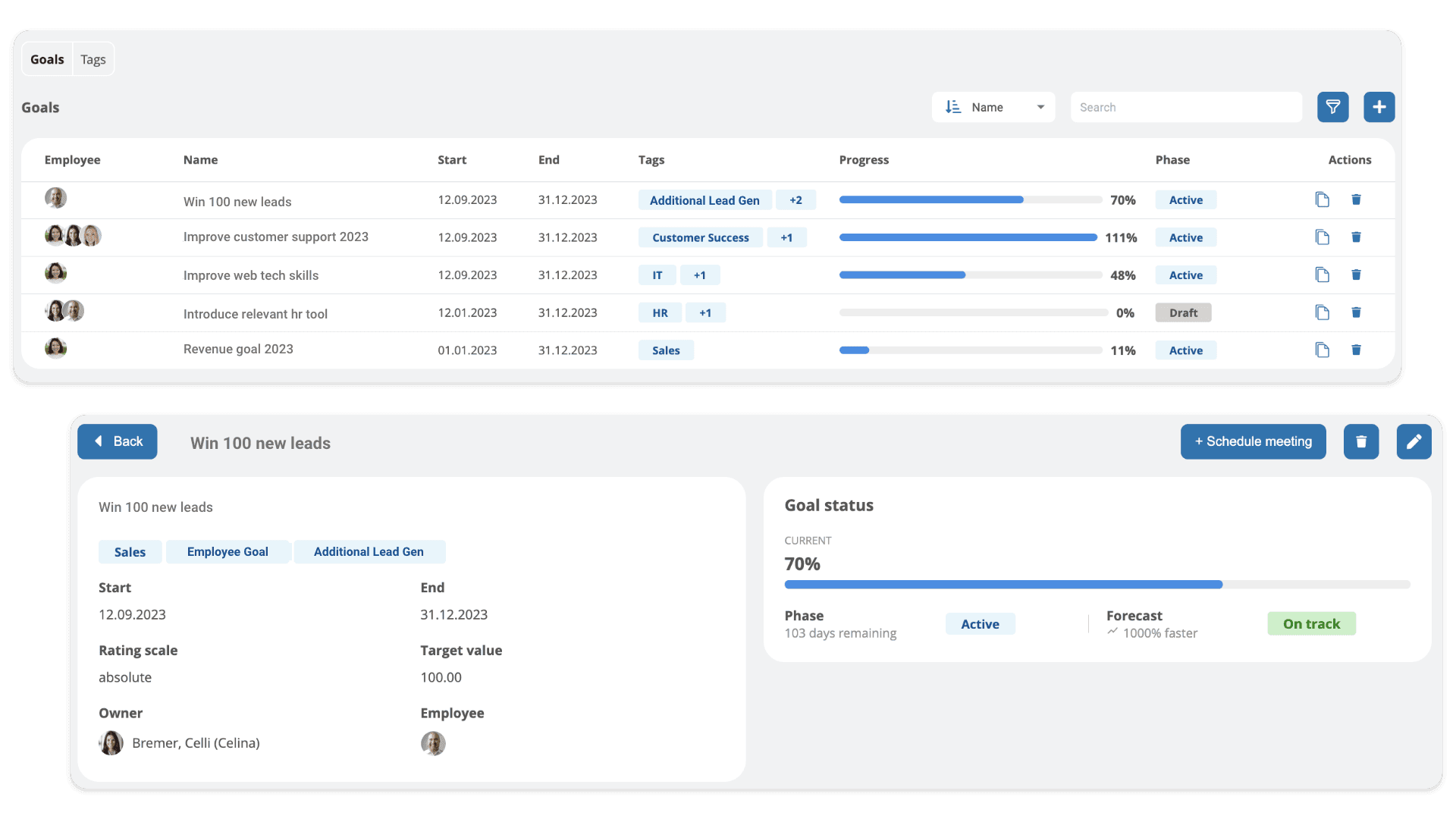
- Goal Setting and Tracking: Goals are cascaded within the system—broken down from the corporate level to departments and individual employees. Dashboards visualize the current achievement rate in real time.
- Feedback Culture and Evaluations: Alongside traditional top-down manager feedback, modern tools facilitate 360-degree feedback. This incorporates anonymized perspectives from peers (peer feedback) and direct reports (upward feedback). Regular pulse surveys can also be managed to gauge team sentiment. -** Performance Analytics and Talent Mapping**: Using standardized evaluation matrices, the software maps employee performance against potential (e.g., 9-box grid). This simplifies the identification of emerging leaders and drives succession management.
- Development and Training Plans: Based on identified performance gaps or potential, people managers can assign concrete development actions directly within the system. Integrating with a Learning Management System (LMS) ensures that professional development is targeted and measurable.
Best Practice: Strategic Embedding within the Overall HR Ecosystem
Digital performance management serves as the central engine and strategic hub for your entire HR process design. Rather than operating in a silo, it systematically connects upstream and downstream HR disciplines.
Upstream, the process relies on a well-defined job architecture and robust job evaluation framework. This foundation significantly improves the quality and comparability of performance reviews. Downstream, the software feeds data into key post-review processes:
Targeted Talent Development
Identify skill gaps and drive targeted interventions—such as training courses, coaching, or on-the-job training—directly from system analytics.
Calibration Sessions and Talent Programs
Leverage aggregated performance metrics to conduct objective calibration sessions across the leadership team. This allows you to nominate top performers and high potentials for internal development programs using software-backed data free from subjective bias.
Proactive Succession Planning
Analyze demographic shifts and turnover risks early. The system highlights key roles at risk due to retirements or vacancies and identifies internal talent ready to step up as successors.
Transparent Compensation and Promotions
Link objective performance metrics directly to transparent merit cycles, bonus distributions, and promotion decisions to measurably elevate organizational fairness.
HR Expert Shares Practical Insights
HR consultant Barbara Wiecher, who has guided HR departments through performance tool implementations for years, highlights on HRlab's podcast "von HR für HR" (By HR for HR) why software alone fails when the fundamentals are missing: A system can only reflect role expectations, not define them—a solid job architecture must already be in place for a tool to make it consistently visible.
How to leverage this framework to conduct genuinely growth-oriented conversations—including calibration sessions and objectively justifying pay decisions in line with the EU Pay Transparency Directive—is explained in detail by Barbara in the full podcast episode "Performance Management in HR: From Judgment to Genuine Dialogue".
AI in Performance Management
The integration of Artificial Intelligence is transforming how managers and HR teams prepare, analyze, and follow up on employee feedback. As Christian Kaller (founder of Loopline Systems) emphasizes on the HRlab podcast, AI does not serve as a replacement for human dialogue, but rather acts as a digital sparring partner and feedback coach.
The 3 Levels of AI Support in 1:1 Reviews
- Meeting Preparation & Drafting: Generative AI assists in drafting feedback that is constructive, appreciative, and free from emotional bias.
- Analysis & Visualization: Tools evaluate peer, manager, and self-assessments, visually mapping out strength and gap profiles (e.g., as spider charts).
- Action Item Generation: Based on review outcomes, AI generates concrete recommendations for targeted training and professional development initiatives.
Critical for HR Decision-Makers: Performance and feedback records are highly sensitive personal data. When deploying AI tools, data protection, access controls, and GDPR compliance must remain top priorities.
FAQ
Which Solutions Are Best for Employee Development?
When it comes to digital employee development for mid-sized businesses, three primary software approaches stand out:
- Integrated all-in-one HR software
- Specialized best-of-breed talent management tools
- Dedicated learning management systems (LMS)
While all-in-one systems like HRlab consolidate all HR processes—from onboarding to performance reviews—within a single database, best-of-breed solutions focus on deep feedback methodologies, and an LMS is dedicated strictly to course administration. For most mid-sized businesses, an all-in-one platform is the optimal choice, as it eliminates data silos and unifies administrative workflows with strategic talent development.
How Can SMEs Ensure Employee Adoption of Performance Management Software?
SMEs secure employee adoption of new performance software primarily through intuitive usability, complete transparency, and early stakeholder involvement. If employees perceive the tool as a monitoring mechanism, engagement drops sharply. HR departments should therefore clearly communicate that the software serves as a development tool designed to map out individual career paths and bring clarity to personal goals. Additionally, an intuitive user experience (UX) minimizes training overhead for both managers and teams. Ensuring GDPR-compliant data privacy alongside open alignment with the works council builds the necessary trust across the workforce.
What Legal Requirements Must SMEs Comply With in Digital Performance Management (in Germany)?
When implementing software-driven performance management in mid-sized businesses, you must primarily comply with the Works Constitution Act (Betriebsverfassungsgesetz - BetrVG) and data protection regulations (GDPR):
Works Council Co-Determination (§ 87 para. 1 no. 6 BetrVG): Because the software digitally processes behavior and performance data, employee representatives have a mandatory co-determination right. A works agreement (Betriebsvereinbarung) must be concluded prior to rollout.
Performance Evaluation Guidelines (§ 94 BetrVG): If the system uses standardized questionnaires, performance reviews, or competency matrices, the works council must explicitly approve the assessment criteria in advance.
Data Protection and Purpose Limitation (Art. 5 GDPR): Performance evaluations are highly sensitive employee data. Implement a strict role-based access control framework for HR and managers, and define binding data retention and deletion schedules.