
Job Description Generator: Create Tailored Profiles Quickly to Boost Recruiting Efficiency
HR professionals use job description generators to reduce the time required to draft initial job postings to just a few minutes and to target qualified candidates effectively. However, generating free text drafts is only the first step in the recruiting process. Companies only truly benefit from seamless, GDPR-compliant workflows when AI-driven text generation is directly integrated into their HR software. Here are the best practices.
Key Takeaways
- Job description generators automate the drafting of role profiles and job descriptions using artificial intelligence.
- Free standalone tools provide quick copywriting assistance, but they create workflow disruptions and isolated data silos in recruiting.
- AI-assisted text generation within HR software (like HRlab) links content creation directly to approval workflows and applicant tracking systems (ATS).
- An integrated software solution also ensures compliance with legal requirements across the entire recruiting funnel.
- Efficiency gains are primarily achieved by eliminating manual data transfer between text editors, career pages, and job boards.
What is a Job Description Generator?
A job description generator is a specialized software solution that automatically creates structured drafts for job postings based on user inputs such as job title, candidate requirements, and company benefits. These generators typically leverage Natural Language Processing (NLP) algorithms and Large Language Models (LLMs) to produce job- and target group-tailored copy that meets candidate expectations as well as search engine optimization (SEO) standards.
3 Core Requirements for a Job Description Generator
The primary function is the error-free drafting of job profiles and vacancies. The generator must flexibly adapt to various employment types (such as full-time, part-time, marginal employment/minijobs, or freelance projects).
- Tone & Messaging: Adaptation of the tone of voice to the respective target audience and appropriate direct messaging.
- Modular Text Blocks: Automatic structuring into company introduction, responsibilities, requirements, and candidate benefits.
- Reduction of Routine Effort: Creation of a complete initial draft within seconds based on bulleted prompts/inputs.
Limitations of Free Standalone Tools
Generic text generators or freely accessible AI tools offer HR departments a quick start into automated copywriting. Within seconds, they provide initial text blocks for responsibilities and job requirements. However, the limitations of isolated tools often only become apparent upon closer inspection:
- Manual Data Transfer: Generated copy must be formatted manually via copy-paste and transferred into job portals or the company’s own career site.
- Lack of Brand Consistency: Company-specific tone of voice and employer branding guidelines can rarely be permanently stored or customized.
- Disrupted Workflows: Coordination with hiring managers and internal approval processes still occur through decentralized email threads or paper printouts.
Sustainable added value is therefore achieved primarily when text generation functions as an integrated feature right where vacancies are managed: within the Applicant Tracking System (ATS) of a comprehensive HR software platform like HRlab.
Integration into the Recruiting Workflow
In HRlab, automated text creation becomes an integral part of the overall recruiting process. The system directly links pure content creation with subsequent administrative talent acquisition steps.
Comparison: Standalone Generator vs. Integrated Recruiting Software
| Criterion | Free Standalone Generator | All-in-One HR Software (e.g., HRlab) |
|---|---|---|
| Text Generation | Via external text prompt | Contextual, directly from the job profile |
| Process Integration | None | Directly linked to applicant tracking, including job board on career page |
| Multiposting | Manual transfer to portals | Automated publishing across multiple job boards |
| Data Protection & Equal Opportunity (AGG) | Requires manual, individual review | Built-in system assistance & GDPR compliance |
Job Description Generation with HRlab in Practice
HRlab embeds automated vacancy text generation as a native AI feature directly into its recruiting module. HR managers can create target-group-tailored job postings without switching software environments—all while complying with German data protection standards.
In-House Hosting & Data Privacy
Text generation in HRlab is powered by an in-house AI model (LLM) hosted on servers managed by HRlab in Germany. No external third-party services are used, ruling out any data transfer to third countries. The system is trained exclusively on anonymized data, ensuring maximum data security.
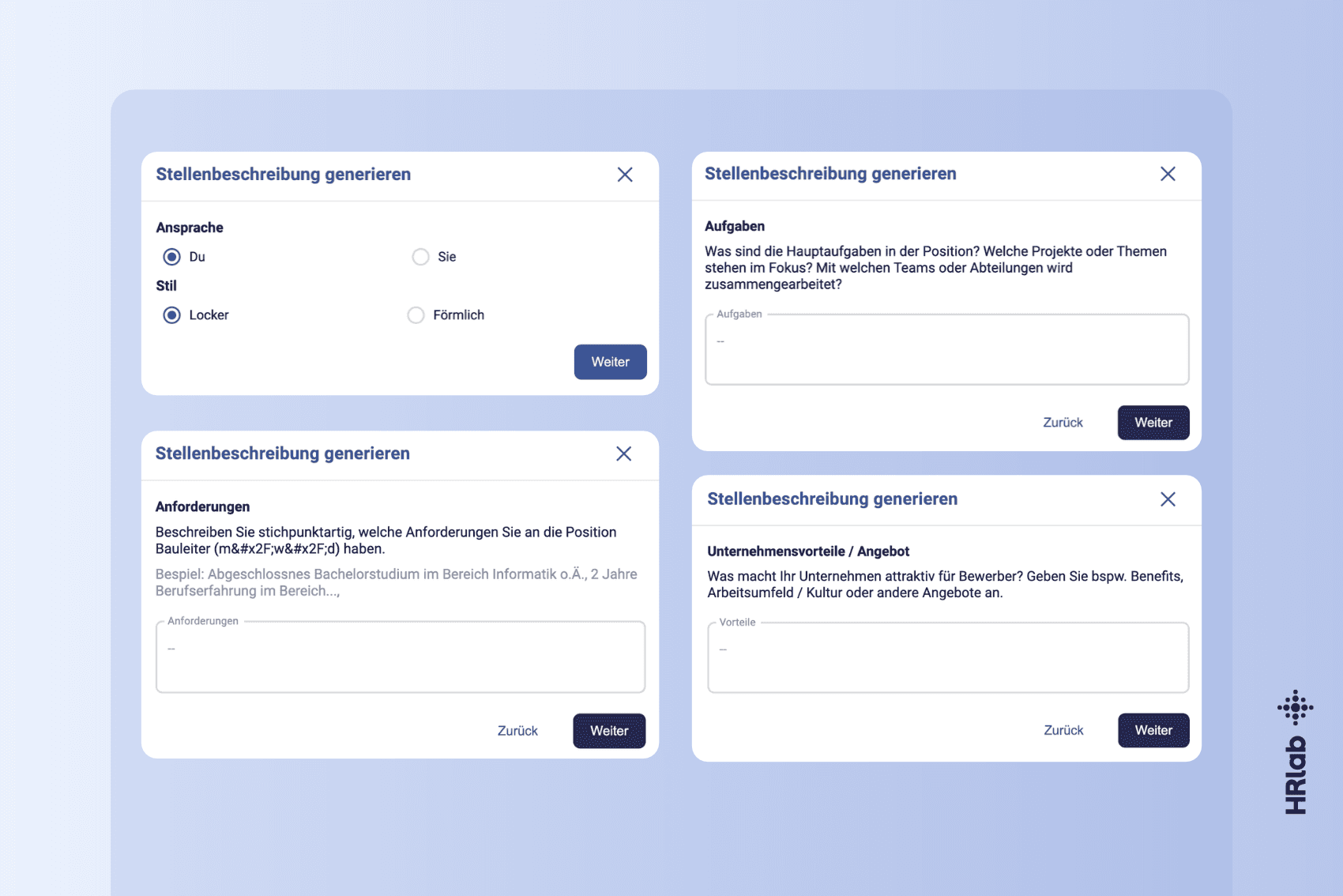
Step-by-Step Creation in HRlab
Creating a tailored job posting within the recruitment module follows a guided five-step process:
Step 1: Generate Job Description
Definition of the primary tone of voice and appropriate form of address (e.g., informal/formal, professional, dynamic).
Step 2: Responsibilities
Brief capture of essential future tasks and responsibilities.
Step 3: Requirements
Bulleted entry of necessary hard skills, soft skills, and qualifications.
Step 4: Company Benefits / Offer
Entry of specific candidate perks, salary bands, or flexible working arrangements.
Step 5: Additional Information & Generation
Addition of general parameters and execution of the AI text generation.
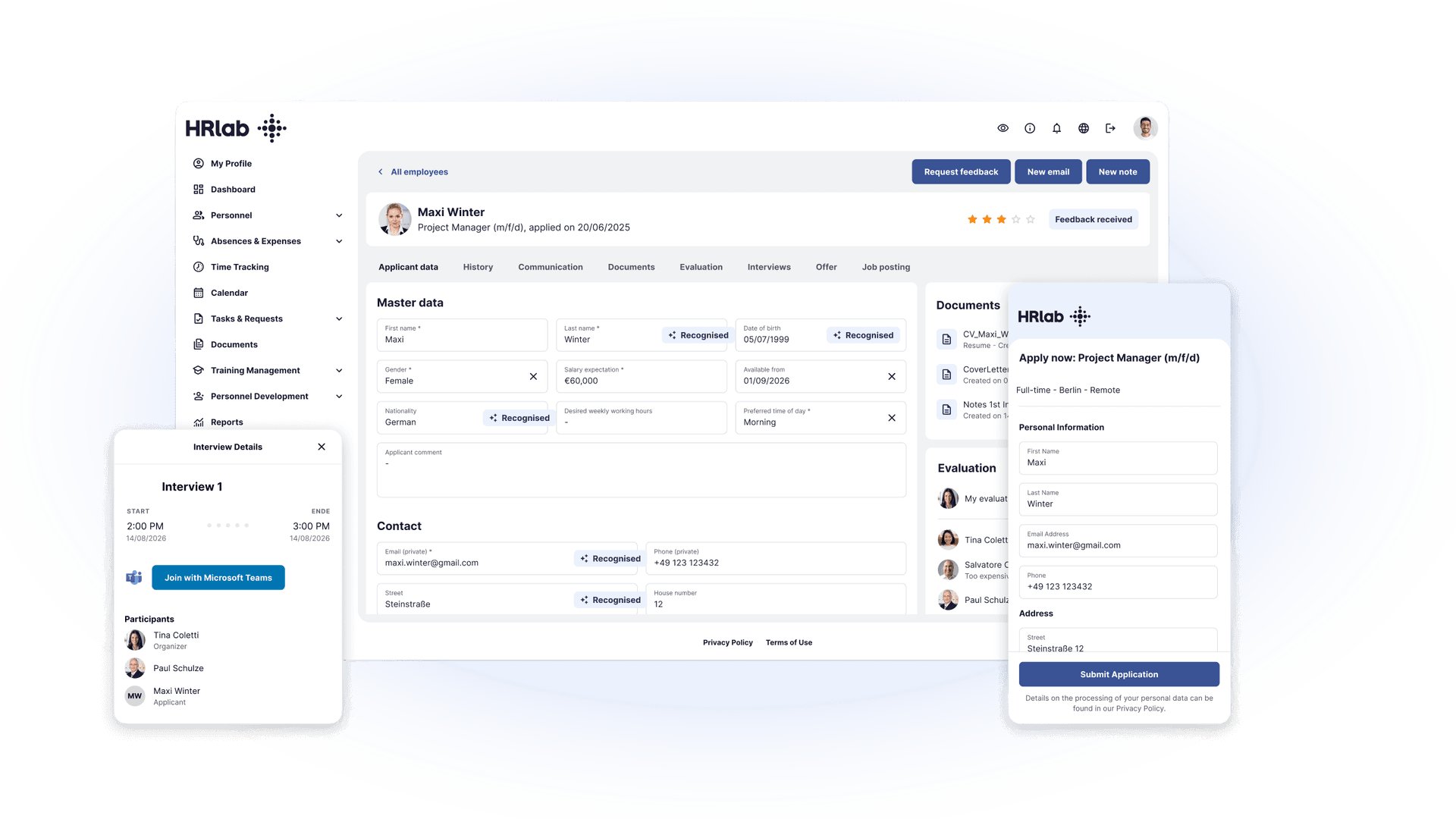
The generated draft text is inserted directly into the job profile. HR teams can refine the text individually and immediately leverage integrated software features such as internal approval workflows, direct publishing, and centralized candidate inbox management.
Legal Framework and Compliance in Job Postings
When drafting job postings, HR teams must comply with legal requirements to mitigate discrimination risks and avoid potential legal liabilities.
German General Act on Equal Treatment (AGG)
According to § 11 AGG, job vacancies must be advertised in a gender-neutral and non-discriminatory manner.
- Gender-Neutral Language: Use neutral job titles or add gender specification suffixes such as (m/f/d) (male/female/diverse) or (m/w/d).
- Prohibition of Discrimination (§ 7 AGG): Job advertisements must not discriminate against anyone based on race, ethnic origin, gender, religion, belief/ideology, disability, age, or sexual identity.
- Indirect Discrimination: Certain terms or criteria can constitute indirect discrimination under § 1 AGG and should be avoided.