Applicant Tracking System: How Application Management Software Works for Small and Medium-Sized Businesses
When used effectively, an ATS can speed up the time-to-hire, improve the candidate experience, and strengthen the employer brand in the long term. Below, we’ll show you exactly how this works using practical processes and examples.
Key Points at a Glance
- Applicant tracking is an essential component of the recruiting process and is part of human resources.
- It encompasses all stages of the application process.
- Applicant tracking System offer many advantages by automating and streamlining these processes.
What is an applicant tracking system (ATS)?
Applicant tracking encompasses all processes and measures a company implements to manage and organize applications. The process begins with creating a job posting and extends through the final hiring decision and onboarding.
An ATS is a software solution that digitally supports and organizes the entire recruitment process. ATS software is used to receive, manage, and process applications; keep track of applicants; and streamline the recruitment process.
Key features include:
- Capturing and storing application documents (resumes, cover letters, and references)
- Managing applicant data in a database
- Pre-screening applicants using filters, scoring, or automated evaluations
- Communicating with applicants via email, notifications, and interview schedules
- Reporting and analyzing the recruiting process (e.g., number of applications and time to hire)
- Integrating with job portals or career sites
Managing Applicants in 9 Steps with Software
Applicant management involves a wide range of strategic and operational tasks. These include creating job postings, posting on multiple channels, communicating with applicants in a structured manner, using AI to pre-screen applicants, and ensuring a seamless transition to digital onboarding. The focus is always on finding the right talent. This occurs when the qualifications and the "cultural fit" are both right.
1. Job Analysis and Description
Process: The candidate management process begins with analyzing staffing needs and creating a precise job description. The job description serves as the basis for the job posting and includes all the necessary qualifications, experience, and responsibilities of the future employee.
Software Support: A digital applicant tracking system, such as HRlab, offers templates and intelligent wizards for creating job descriptions. This feature facilitates standardization and ensures precise requirements definitions. It allows the team to quickly generate a professional job posting without errors.
2. Publishing the Job Posting
Process: The completed job description is published across various channels, such as the company’s career page, job portals, and social media.
Software support: For example, HRlab’s applicant tracking system includes multiposting features. With just one click, the job posting is published simultaneously on multiple job boards and social media platforms. This saves time and increases reach among potential candidates. Additionally, a career page can be linked to the client’s website with just a few clicks within the application, allowing potential candidates to apply directly.
3. Collecting and Centrally Managing Applications
Process: As soon as applications are received, they must be collected and evaluated. This is usually done according to predefined criteria to ensure that all applications are assessed objectively and fairly. These criteria may include the applicants’ professional qualifications, work experience, and personal qualities, among other things.
Software support: Applicant management systems provide a central database for all applications. An applicant tracking system (ATS) automatically imports applications and stores them in a structured manner. This allows HR managers to maintain an overview and avoid data inconsistencies. AI-powered features in HRlab, such as CV parsing, enable the system to easily extract and collect information.
4. Pre-selection and Evaluation of Applicants
Process: A preliminary selection is made based on defined criteria, such as qualifications, experience, and soft skills.
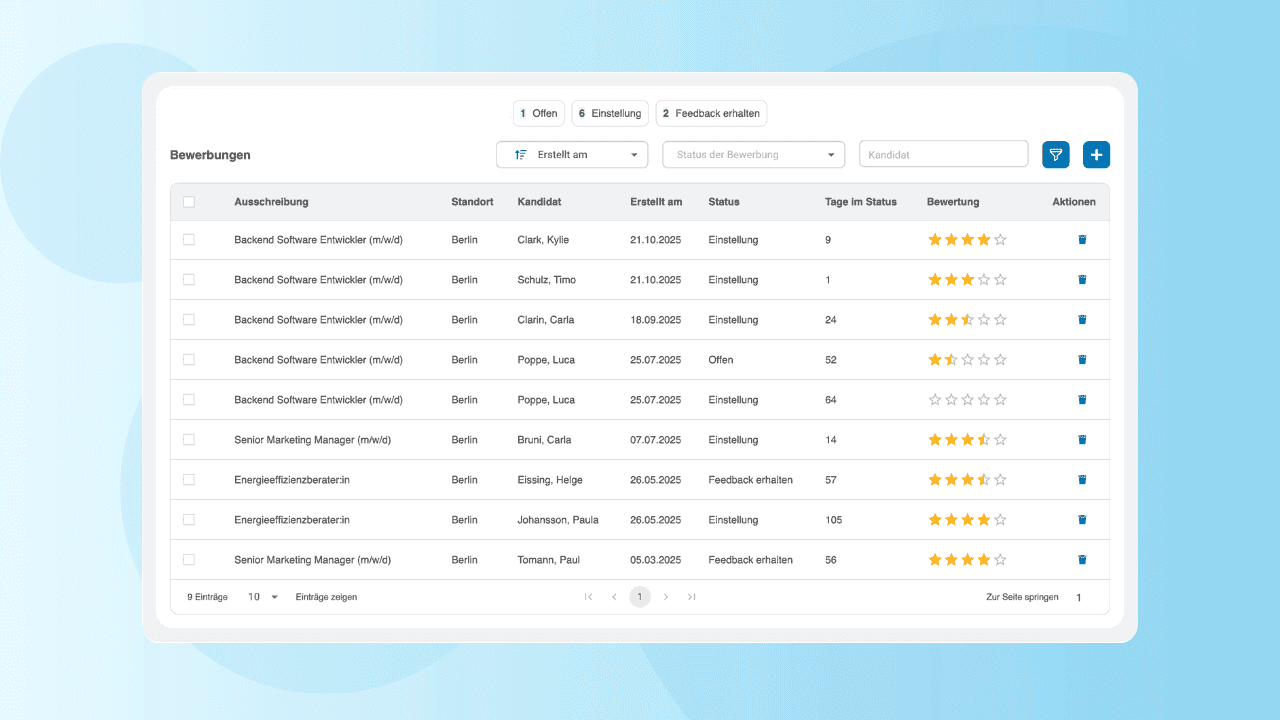
Software support: Applicant tracking systems offer filtering functions and scoring models. HRlab provides a quick-view feature that displays an overall rating of the candidate or application. This rating is derived from all evaluations submitted for that application. This allows talent to be automatically evaluated and sorted according to predefined criteria. This accelerates the selection process and increases objectivity.
5. Candidate Communication
Process: Communicating with candidates is an essential component of applicant tracking systems. It should be timely, friendly, and professional in order to create a positive impression of the company. This includes confirming receipt of applications and notifying candidates of the next steps in the process. Effective communication ensures a positive candidate experience.
Software Support: Many applicant tracking system solutions include features for automated and personalized candidate communication. These systems can send email templates, automatic acknowledgments of receipt, and notifications about status changes directly and quickly. HRlab offers features such as a communication log and the ability to give and collect direct feedback regarding candidates.
6. Planning and Conducting Interviews
Process: Coordinating and conducting job interviews is another key task. This involves planning, conducting, and evaluating interviews to gain a comprehensive understanding of candidates. In addition to the HR department, line departments are often involved in this process.
Software support: An integrated applicant tracking system with calendar integration and interview scheduling tools can facilitate appointment coordination. With HRlab, for instance, notes and evaluations can be digitally recorded and linked to the applicant’s profile.
7. Selection Decision and Job Offer
Process: Based on all the gathered information, the final selection is made and the suitable candidate receives a job offer.
Software support: A modern HR tool like HRlab supports this process with decision-making functions and workflow automation. Contracts can be prepared and sent with integrated e-signatures. This significantly reduces administrative overhead.
8. Rejection Letters and Feedback to Rejected Applicants
Process: It is just as important to send rejection letters to those who were not selected as it is to offer a position to the selected candidate. This should be done in a respectful and appreciative manner. If possible, provide constructive feedback to help applicants prepare for future applications.
Software support: Some applicant tracking systems, such as HRlab, enable automated rejection processes. With customizable text templates, these systems streamline communication to ensure respectful and transparent rejections.
- Onboarding New Employees Process: After signing the contract, the new team member is integrated into the company through onboarding.
Software support: Modern HR software often comes equipped with onboarding modules, or they can be integrated. These modules provide welcome information and training and help organize the first few days of work. This makes the start easier and promotes employee retention. HRlab’s self-service feature allows new hires to easily enter their personal information before their first day of work.
Use Case: Applicant Management Software for Mid-Sized Businesses
The SEH Group is a midsized company in the sports sector with approximately 500 employees and locations in Hamburg and Munich, among other places. The company faced the challenge of efficiently managing applications. Previously, applications were received by various HR staff members, which often led to confusion about the status of individual candidates and complicated communication during the recruiting process.
Due to its rapid growth and wide variety of employment arrangements, the SEH Group faced challenges in establishing consistent structures for the application process. There was no centralized overview of where candidates were in the process, and important information was sometimes lost.
HRlab's solution was a centralized applicant management system that consolidates all incoming applications and makes their current status transparent at all times. The software enables applications to be recorded, tracked, and shared in a structured manner with all relevant colleagues. Automated workflows efficiently manage notifications, tasks, and reminders, ensuring that no applications "fall through the cracks" anymore.
Data Protection and GDPR in Applicant Management
Application documents contain sensitive personal data, such as contact details, professional backgrounds, references, salary expectations, and, in some cases, health data. Companies must ensure that this data is processed solely for the specified purpose and that unauthorized access is prevented.
According to the GDPR and the BDSG, processing applicant data is generally permitted if necessary for making a hiring decision. In Germany, Section 26(1) of the BDSG applies. Once the application process is complete, personal data must be deleted as soon as it is no longer required. HRlab and other applicant tracking systems have integrated automated deletion routines for this purpose.
FAQ
What does applicant tracking involve?
It involves posting job listings, evaluating applications, communicating with applicants, conducting interviews, making hiring decisions, extending job offers, sending rejection letters, and providing feedback. In other words, it encompasses the entire application process.
What recruiting methods are available?
The most common methods include job postings, social recruiting, active sourcing, and career fairs.
How do I find the right applicant tracking system for my medium-sized business?
- Determine which features are essential for your recruiting needs.
- Look for user-friendliness and support.
- Ideally, test the software during a demo or trial period.
- Compare pricing models and potential additional costs.