Travel Expense Allowances: Current Rates, Table & Rules for HR
The travel expense allowance (Reisekostenpauschale) in Germany is a flat-rate amount recognised for tax purposes that covers work-related costs incurred on business trips. These mainly include travel costs, additional meal expenses, accommodation costs and other incidental expenses.
Key facts
- Travel expense allowances simplify expense claims because employees don't have to submit every single receipt.
- They include flat rates for additional meal expenses, travel costs, accommodation and incidental travel expenses.
- For trips abroad, the allowance amounts are always based largely on the cost of living in the country concerned.
What is the travel expense allowance in Germany?
The travel expense allowance is a fixed amount set by tax law to cover additional work-related expenses (travel, meals, accommodation). In Germany, the meal allowance is currently €14 (for absences of more than 8 hours) or €28 (24 hours), while the mileage allowance for cars is €0.30/km.
All travel expense allowances for 2027 at a glance (table)
The travel expense allowance is a statutory flat rate (Section 9(4a) German Income Tax Act, EStG) that lets employers reimburse additional work-related expenses tax-free when employees work away from their usual workplace. It simplifies expense claims for employees, self-employed people and HR departments, because nobody has to collect individual receipts for meals or trips in a private vehicle.
| Component | Allowance 2027 (Germany) | Applies to / requirement |
|---|---|---|
| Additional meal expenses (> 8 hrs) | €14 | Absences of more than 8 hours, plus arrival and departure days of multi-day trips |
| Additional meal expenses (24 hrs) | €28 | Full 24-hour absence (00:00 to 24:00) |
| Travel costs (private car) | €0.30/km | Business trips (outbound and return) in your own car |
| Travel costs (motorbike/scooter) | €0.20/km | Business trips by motorbike, scooter or moped |
| Overnight allowance | €20/night | Only for tax-free reimbursement by the employer (without individual receipts) |
| Incidental travel expenses | Actual costs | No flat rate – reimbursed against receipts (e.g. parking fees, tolls, public transport tickets) |
| Allowances abroad | Country-specific | Adjusted on 1 January 2027 in line with the Federal Ministry of Finance (BMF) circular (published in early December) |
Why the allowance was introduced
Travel expenses usually arise in connection with business trips – in other words, whenever employees, public sector staff or self-employed people work away from their usual workplace, for example at trade fairs or client meetings.
The idea behind the travel expense allowance is to make expense claims much simpler, as far fewer individual receipts need to be submitted and checked.
That's why HR teams use travel expense allowances to simplify expense claims for employees while complying with the statutory requirements for wage tax and income tax.
Typical use cases include:
- Business trips
- Project work at client sites
- External training courses
- Business trips in a private car
Additional meal expenses in Germany & reduction rules
When employees travel for work (away from their first place of work), the law assumes that eating on the road costs more than eating at home. The statutory domestic rates remain unchanged in 2027:
Half-day allowance (€14): Applies to single-day trips of more than 8 hours and, as a flat rate, to the arrival and departure days of a multi-day business trip (regardless of the actual number of hours). Full-day allowance (€28): Applies to every full calendar day (24-hour absence) of a multi-day business trip. Reducing the meal allowance when meals are provided
If the employer – or a third party on the employer's behalf (e.g. a hotel with breakfast included or a client invitation) – provides a meal, the daily allowance must be reduced by law. Important: The reduction is always calculated on the full-day allowance of €28 – even on arrival and departure days (€14).
| Component | Allowance 2027 (Germany) | Applies to / requirement |
|---|---|---|
| Additional meal expenses (> 8 hrs) | €14 | Absences of more than 8 hours, plus arrival and departure days of multi-day trips |
| Additional meal expenses (24 hrs) | €28 | Full 24-hour absence (00:00 to 24:00) |
| Travel costs (private car) | €0.30/km | Business trips (outbound and return) in your own car |
| Travel costs (motorbike/scooter) | €0.20/km | Business trips by motorbike, scooter or moped |
| Overnight allowance | €20/night | Only for tax-free reimbursement by the employer (without individual receipts) |
| Incidental travel expenses | Actual costs | No flat rate – reimbursed against receipts (e.g. parking fees, tolls, public transport tickets) |
| Allowances abroad | Country-specific | Adjusted on 1 January 2027 in line with the Federal Ministry of Finance (BMF) circular (published in early December) |
New for 2027: When the benefit-in-kind value applies to trips (< 8 hours)
On 1 January 2027, the official benefit-in-kind values (Sachbezugswerte) will rise (17th Ordinance amending the Social Security Remuneration Ordinance, Bundesrat document 503/26). For travel expense claims, these values apply whenever no meal allowance is due – i.e. for short business trips with an absence of no more than 8 hours.
If the employer pays for a customary meal (up to a maximum of €60 gross) on a short trip like this, it counts as taxable pay subject to social security contributions and is valued at the favourable official benefit-in-kind rate:
| Meal / benefit in kind | Daily value 2026 | Daily value 2027 | Monthly value 2027 |
|---|---|---|---|
| Breakfast | €2.37 | €2.43 | €73 |
| Lunch | €4.57 | €4.70 | €141 |
| Dinner | €4.57 | €4.70 | €141 |
| All meals (full board) | €11.50 | €11.83 | €355 |
| Free accommodation | €9.50 | €9.63 | €289 (2026: €285) |
Worked example (absence < 8 hours)
An employee spends 6 hours at a client meeting and the company pays €18 for her lunch. As she isn't entitled to the €14 allowance, the meal is valued at the benefit-in-kind rate of €4.70 (which the employer can tax at a flat rate of 25% under Section 40(2) EStG). Any contribution the employee makes towards the meal reduces the benefit-in-kind value. If the meal costs more than €60, it no longer counts as a customary meal and must be taxed at its actual price.
Overnight allowance & travel costs
- Accommodation costs: a key difference for employers and employees
- Tax-free reimbursement by the employer: For overnight stays in Germany, employers can reimburse a flat €20 per night tax-free without a hotel receipt. If the actual accommodation costs are higher and backed by an invoice, the full amount (minus any breakfast shown on the bill) can be reimbursed tax-free.
- Income-related expenses / business expenses: Employees filing their own income tax return and self-employed people cannot claim the €20 overnight allowance – only actual, documented accommodation costs count here.
##Travel costs: mileage allowance vs. commuter allowance
For business trips in a private vehicle, the flat mileage rates continue to apply to every kilometre driven (outbound and return, plus journeys at the destination):
- Car: €0.30 per kilometre
- Motorbike, scooter, moped: €0.20 per kilometre
- Public transport (train, bus, flight, taxi): Reimbursed in full against receipts.
Important distinction: Don't confuse the tax-free mileage allowance for business trips (€0.30/km for outbound and return journeys) with the commuter allowance (Entfernungspauschale) of €0.38 from the first kilometre, which applies only to the one-way distance between home and the first place of work. (Note: A flat bicycle allowance of €5 per month no longer exists under general tax law; it only applies under specific collective agreements or for travel expenses in the public sector under the Federal Travel Expenses Act, BRKG.)
Travel expense allowances abroad (BMF table)
For trips abroad, the flat rates for additional meal expenses and accommodation depend on the cost of living in the destination country. The BMF traditionally publishes the new allowances abroad for 2027 in the first week of December (in previous years on 2 December 2024 and 5 December 2025).
Two key rules for trips abroad:
- Midnight rule for multi-day trips: The allowance for a calendar day is always based on the country the traveller reaches before 24:00 local time.
- Regional differences: Higher rates apply to certain major cities within some countries (e.g. Geneva and Zurich in Switzerland, or New York and San Francisco in the USA).
Claiming business travel expenses for tax purposes
If the employer doesn't reimburse travel expenses, employees can claim their work-related additional expenses as income-related expenses (Werbungskosten) in their income tax return. Self-employed people deduct the costs as business expenses and can reclaim the VAT shown on proper invoices as input tax.
How HR software simplifies travel expense claims
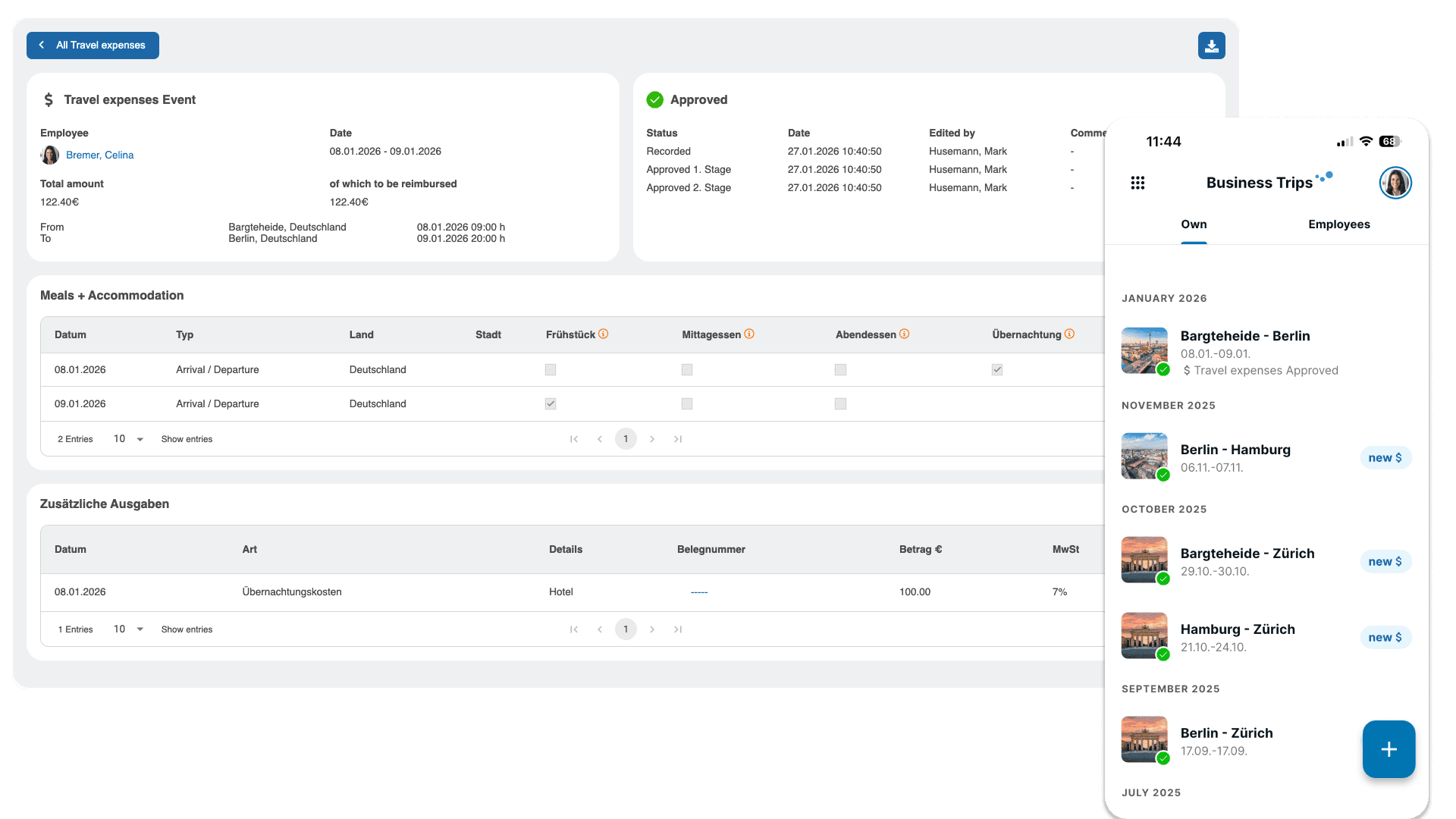
To reimburse additional expenses from a business trip, you need a travel expense claim. HR software such as HRlab or a comparable provider makes this process much easier: you simply enter the trip details in the tool and the relevant allowances are calculated automatically. In HRlab, this is done intuitively with the Business Trips feature.
Additional costs such as incidental travel expenses can easily be uploaded with receipts. The claim is then automatically sent to the line manager for approval. Done.
As a general rule, however, you must always collect and submit receipts for any expenses that aren't covered by a flat rate.
Note: When it comes to allowances, you then need to adjust for the meals actually provided. So if breakfast was included at the hotel or you were invited to dinner, this must be reflected in the expenses claimed.