
HR Technologies
Documenting Employee Conversations in the Personnel File: Here's How

Marlen Kothen
on August 21, 2026 • 5 min. reading time
Employee conversations are part of everyday HR work, and yet practice repeatedly shows that uncertainties and pitfalls often arise, particularly when it comes to documenting employee conversations in the personnel file. We reveal how you can not only simplify the process but also professionalize HR work as a whole.
What role does the personnel file play for employee conversations?
The personnel file is, so to speak, the central memory of the HR department. All relevant information about an employee's employment comes together here: from contract documents and qualifications to conversation records.
However, a complete, traceable picture only emerges once employee conversations are also consistently documented in the personnel file — including minutes, agreed goals, and specific measures. Only this way can it be traced afterward which agreements were made and how topics or developments changed over time.
The advantage: a properly maintained personnel file protects both sides. It creates transparency, ensures clarity, and provides a solid basis in the event of queries or conflicts.
Is there a legal requirement?
There is no general legal obligation to record the minutes of every employee conversation or to file the minutes in the personnel file. It only becomes binding when a collective agreement, works/service agreement, or internal guidelines require documentation.
What characterizes professional software documentation?
Software for documenting employee conversations ensures that the minutes cover all essential components in an audit-proof manner:
- Basic data: Automatic recording of date, participants, occasion, and meeting location.
- Customizable templates: To establish uniform guiding questions for self-assessments and assessments by others.
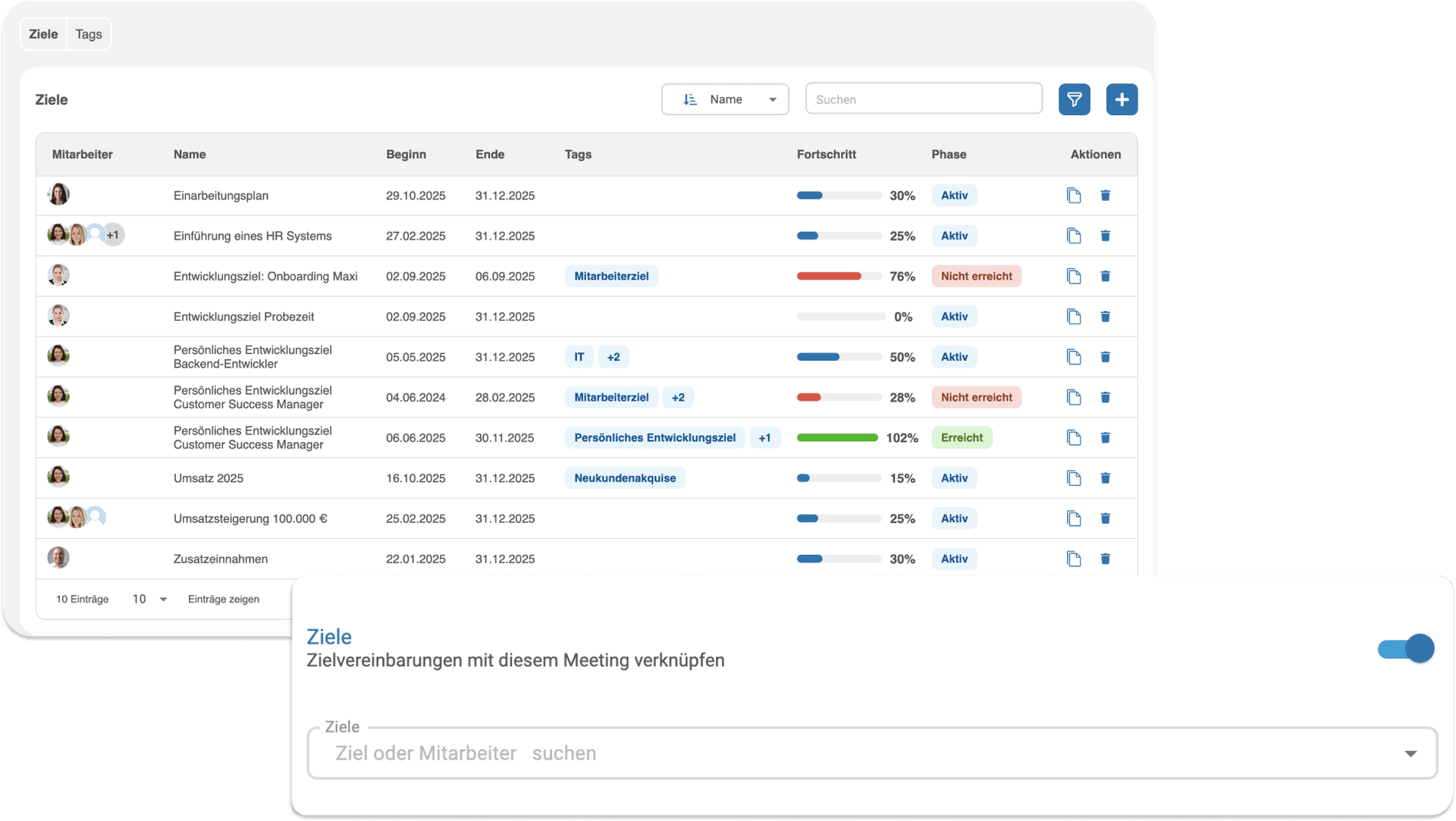
- Goal tracking: Measurable goals including timeframe, progress, and status.
- Development strategy: Documentation of training and development measures.
- Legal certainty & audit security: Digital confirmation by manager and employee with version history.
Best practice: documenting employee conversations with HR software
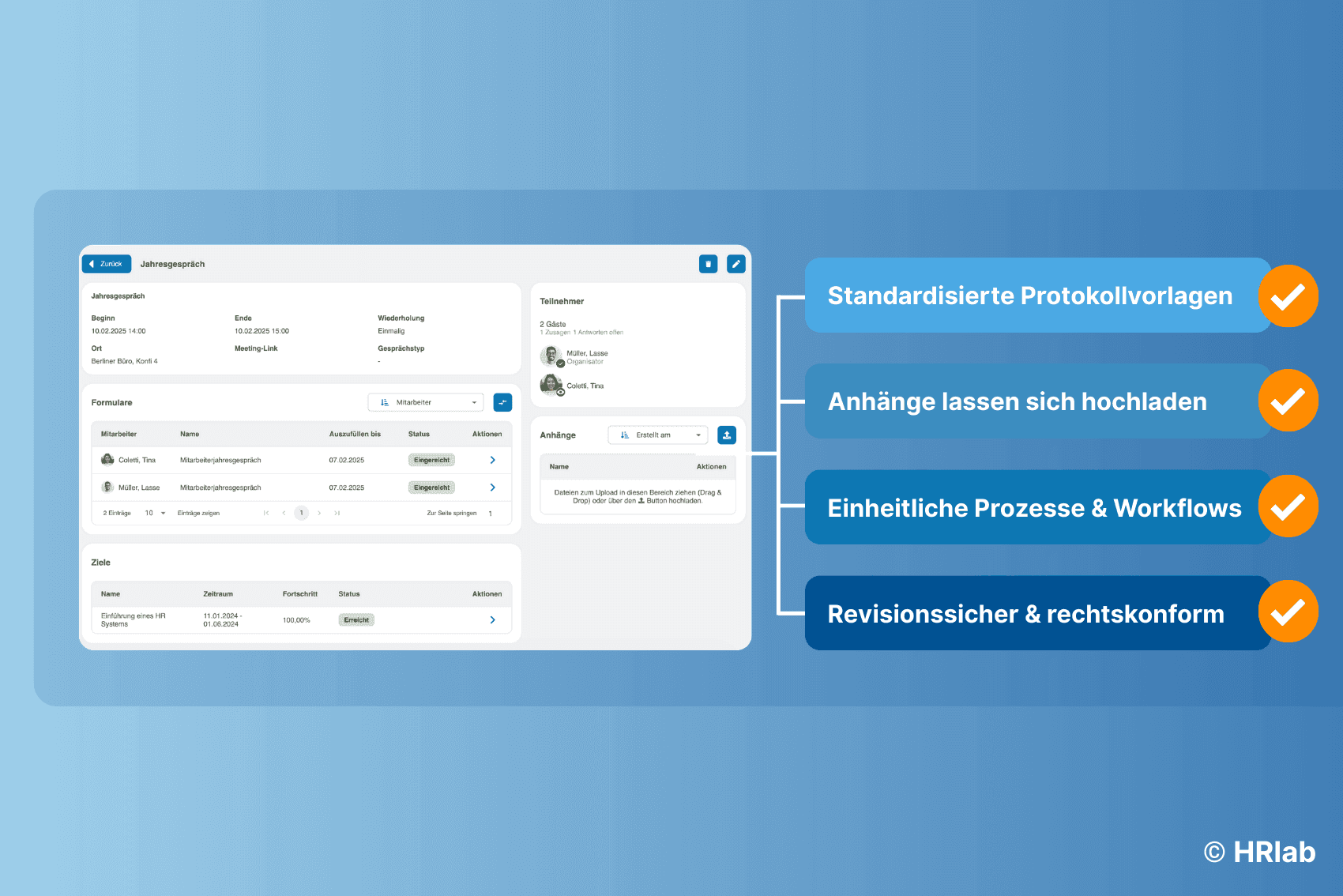
Ideally, the personnel file is already part of a digital HR ecosystem via HR software. HR software like HRlab offers various functions for employee conversations to easily avoid the errors listed above. In the system, minutes templates can be set up as standard in the form of digital protocol sheets that cover all relevant points — reason for the conversation, participants, content, goals, and measures.
Attached files and documents can be accessed via the Attachments section. This allows you to upload, for example, documents relating to a salary adjustment or other documents. This ensures that nothing important gets lost.
In HRlab, all minutes are stored centrally in the digital personnel file. The conversation results are audit-proof, meaning that every change generates a new results version. The clever part: every results version can be confirmed or rejected by all meeting participants. This way, approval of agreed measures can be logged and tracked directly in the system.
Uniform processes for recording minutes create fixed structures, clear guidelines for content, and standardized workflows. Corresponding training for managers ensures consistency and comparability in the long run.
With HR software, you create and store minutes for a specific purpose and in compliance with data protection regulations. The digital personnel file, with integrated permission management, adjustable retention periods, and deletion concepts, forms the perfect bridge to documenting employee conversations.
4 Common Mistakes in Documenting Employee Conversations in the Personnel File
1. Incomplete minutes
Often, only bullet points or rough key statements are recorded. Important decisions, goal agreements, or even specific measures are missing. This makes later traceability more difficult and makes systematic evaluation almost impossible.
2. Incorrect filing and media discontinuities
Minutes are indeed created, but they don't consistently end up in the personnel file. Instead, they sit in private folders, email inboxes, or on local drives. However, if conversation minutes are not filed centrally in the personnel file, in case of doubt no one knows:
- where the document is located
- whether it is the current version
- whether it even exists
This leads to considerable loss of time, especially during personnel changes, absences, or when someone is standing in for another employee.
3. No standardized process
When every manager documents conversations differently, comparability suffers. Some minutes are detailed, others very brief. Without clear guidelines or digital workflows, the value of employee conversations in the personnel file drops significantly.
4. Lack of legal certainty
A common mistake in practice is that conversation minutes are indeed created, but their legal classification is underestimated. In fact, minutes of employee conversations are almost always personal data. This means they are subject to clear legal requirements, particularly from data protection and labor law.
What HR should keep in mind: Conversation minutes regularly contain information about:
- performance and behavior
- criticism, conflicts, or misconduct
- development potential, goals, or health-related aspects
This means they fall under:
- Art. 4 No. 1 GDPR (personal data)
- possibly Art. 9 GDPR (special categories of personal data), e.g., in cases involving health information
In addition, Section 26 of the German Federal Data Protection Act (BDSG) applies in the employment context. This means that processing is only permissible if it is necessary, purpose-bound, and proportionate.