
General HR
Payroll Accounting Examples: In-House Solution vs. Full-Service Agency

Marlen Kothen
on June 19, 2026 • 5 min. reading time
While the workforce is happy to see their pay arrive at the end of the month, the HR department often looks back on intense days full of data checking. Many companies outsource the entire process to external service providers. But in practice, even the supposed "all-inclusive worry-free package" doesn't free the HR department from the core work. We show concrete payroll accounting examples from practice and explain how data quality stands or falls in-house.
Why outsourcing doesn't save you from preparation
It's one of the most persistent misconceptions in HR: "We have an external payroll firm, so we have no work to do with payroll." A look behind the scenes shows a different picture. No external service provider and no tax advisor knows your workforce.
They don't know who moved last month, who worked overtime, or how high sales commissions are. The external payroll firm only handles the mathematical and legal execution—calculating taxes and social security contributions. Collecting, validating, and structuring the data remains an HR task.
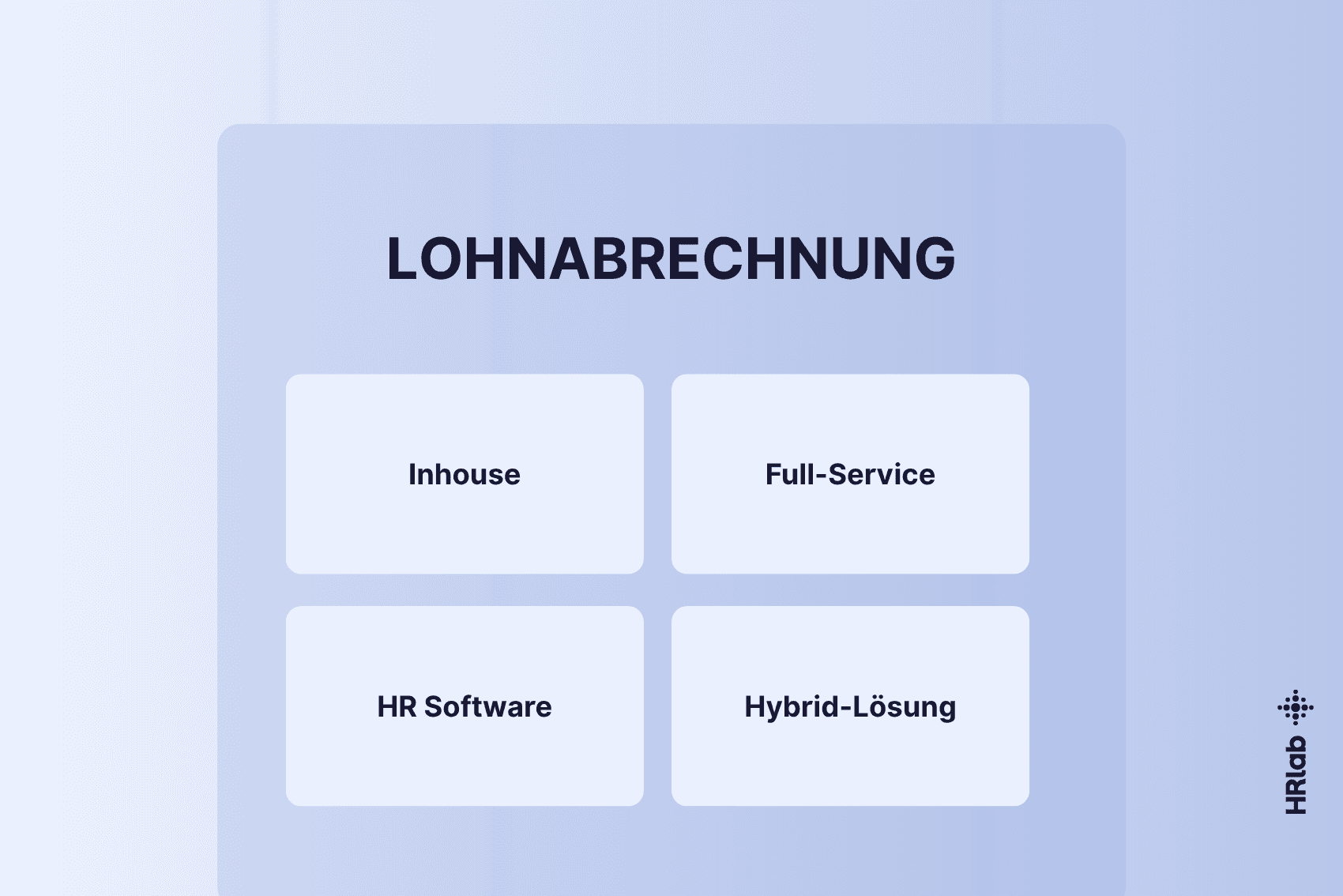
Four examples of how companies handle wage and salary accounting
To set up payroll within the company, HR managers and leadership usually face a choice between three operating concepts. Each model has a direct impact on efficiency in accounting.
Example 1: In-house payroll accounting
The entire system is run internally. A dedicated specialist calculates and processes salaries directly within the company. Advantage: full control, short decision-making paths, and deep knowledge of one's own workforce. Disadvantage: for smaller companies, fixed costs can be disproportionately high—a specialized employee incurs salary and social security costs regardless of the actual workload.
On top of that, there are ongoing software license costs and annual training costs, since tax and social security law changes regularly. Above a certain company size, these costs become more proportionate. There's also a high risk of disruption if the payroll specialist is sick or on vacation.
Example 2: Fully outsourcing payroll accounting
The entire payroll process is handed over to an external agency. We spoke with Silas Kropf in an interview about the general possibilities of outsourcing in HR. Service providers like him offer a wide range of support in the area of wages and salaries, for example:
- Preparatory payroll accounting
- Coordination with the payroll office
- Reviewing pay statements
- Reviewing travel expenses
- Maintaining variable pay components
- Creating reports
Advantage: execution lies with the service provider—internal training effort is largely eliminated. For SMEs without their own payroll resources, this model is often the easiest way in.
Disadvantage: structuring all payroll-relevant information still doesn't disappear 100% for HR. Depending on the provider, subsequent corrections or even the smallest changes to master data can trigger extra costs.
Example 3: HR software for data preparation and interfaces
The HR department uses HR software such as HRlab for automated data preparation and hands off the validated data with a single click to the interface with the payroll system (e.g., DATEV). HR retains data sovereignty while outsourcing the mathematical complexity risk of the final payroll calculation.
Advantage: automation significantly reduces sources of manual error. Master data changes, variable salary components, or travel expenses flow into the payroll process in a structured, verified way—without a break in the media. For growing companies that want to combine efficiency and control, this model is especially economical, because no dedicated payroll specialist is needed while at the same time no data is passed on to external service providers.
Disadvantage: initial implementation requires time and resources. The HR team needs to be trained, and the quality of the output depends directly on the care taken in maintaining data within the system.
Example 4: The hybrid model
In practice, when it comes to payroll accounting, companies don't necessarily face an either-or choice between HR software and outsourcing. In the hybrid model, the company retains data sovereignty via its own HR software, while an external service provider connects remotely into the system and takes on operational tasks directly. For growing SMEs looking for relief without losing control, this can be a pragmatic solution.
Case study: how a digital agency cut its payroll time in half
Just how drastic the leverage effect can be in practice is shown by this payroll example from the digital agency Löwenstark. With over 230 employees—around 80 of them fully remote/home office—and a complex structure of 10 independent GmbHs, the HR team faced a massive bureaucratic hurdle.
The starting situation:
Before switching to HRlab, data was maintained in incompatible partial solutions and cluttered Excel lists. The result: data had to be entered twice, errors crept in from one report to the next, and simply setting up a new team member alone ate up 45 minutes of valuable HR working time.
The solution:
Introducing HRlab as a central single source of truth with a direct, seamless DATEV connection. The measurable result: despite rapid growth to almost double the number of employees, the HR team today needs only half as much time for preparatory payroll accounting as before. The error rate dropped to zero, while manually typing in movement data in HR has, based on these examples, become a thing of the past for good.
Conclusion
Various payroll accounting examples show which model is most efficient for companies: in-house, full outsourcing, HR software, or a hybrid solution. The decisive factor is always the quality of data preparation—regardless of which model is chosen.