
General HR
Knowledge Loss in Companies: How SMEs Can Prepare

Marlen Kothen
on October 2, 2026 • 4 min. reading time
When long-standing employees retire, they take decades of experience, established networks, and unwritten routines with them. The result is a gradual loss of knowledge within companies that can paralyze administrative workflows and lead to significant financial damage.
What Is Knowledge Loss and Where Is the Heat On in 2026?
Knowledge loss in companies refers to the unintentional outflow of operationally relevant expertise. Experts distinguish between two types of knowledge:
- Explicit Knowledge: Documented data, manuals, contracts, or code that are easily accessible and can be stored digitally.
- Implicit Knowledge: Invisible, experience-based knowledge. It includes gut-feeling decisions, crisis routines, personal relationship management with key clients, and individual tricks of the trade that were never written down because they were taken for granted.
It is precisely this implicit knowledge that is currently at risk for many organizations. An exclusive analysis by HRlab based on data from the Federal Employment Agency (Bundesagentur für Arbeit) highlights the regional urgency: across Germany, approximately 4.2 million employees aged 60 and older are currently contrasted with around 2.6 million junior staff members (ages 20 to 25). This corresponds to a nationwide replacement ratio of 163 older workers for every 100 entry-level professionals.
The Replacement Ratio: A Regional Comparison in Germany
The risk of impending knowledge loss varies dramatically by region, as shown in the following analysis of selected areas:
| Region / District | Employees 60+ per 100 Entrants | Share of 60+ Employees in Workforce | HR Risk Profile |
|---|---|---|---|
| Spree-Neiße (Brandenburg) | 292 | > 16.0% | Acute need for action: Highest risk of knowledge loss nationwide. |
| Saxony-Anhalt (State average) | ~ 200 | ~ 15.1% | Very high: Extremely thin talent pipeline in the region. |
| Cloppenburg (Lower Saxony) | 114 | ~ 10.2% | Moderate: Relatively balanced, but still no surplus of junior staff. |
| Ingolstadt (Bavaria) | 115 | 8.2% | Stable: Strong appeal as an industrial location cushions the age demographic. |
| Germany (National average) | 163 | 12.1% | Structural change: In every district, more older employees leave than young workers join. |
Hidden Costs: Why Knowledge Loss Burdens Companies
Vacant positions can be listed through recruitment, but years of experience tied directly to internal company processes cannot simply be bought through a job ad. When knowledge drains unchecked, both direct and indirect costs follow. Analyses show that unmanaged knowledge loss incurs massive costs due to:
- Extended Onboarding Times: Successors have to reinvent the wheel because documentation is missing or incomplete.
- Higher Error Rates: Critical process steps are missed, leading to quality deficiencies and customer dissatisfaction.
- Loss of Networks: Long-standing customer and supplier relationships often depend on single individuals. If that person leaves, the connection weakens.
When experience leaves, it leaves behind more than an open spot on the organizational chart—it leaves a hole in the company’s memory. Starting handovers just three months prior to retirement is usually far too late.
How Companies Can Prevent Knowledge Loss
Knowledge transfer does not happen at the touch of a button; it must be planned early on. HR professionals who take proactive steps secure a clear competitive edge for their organizations.
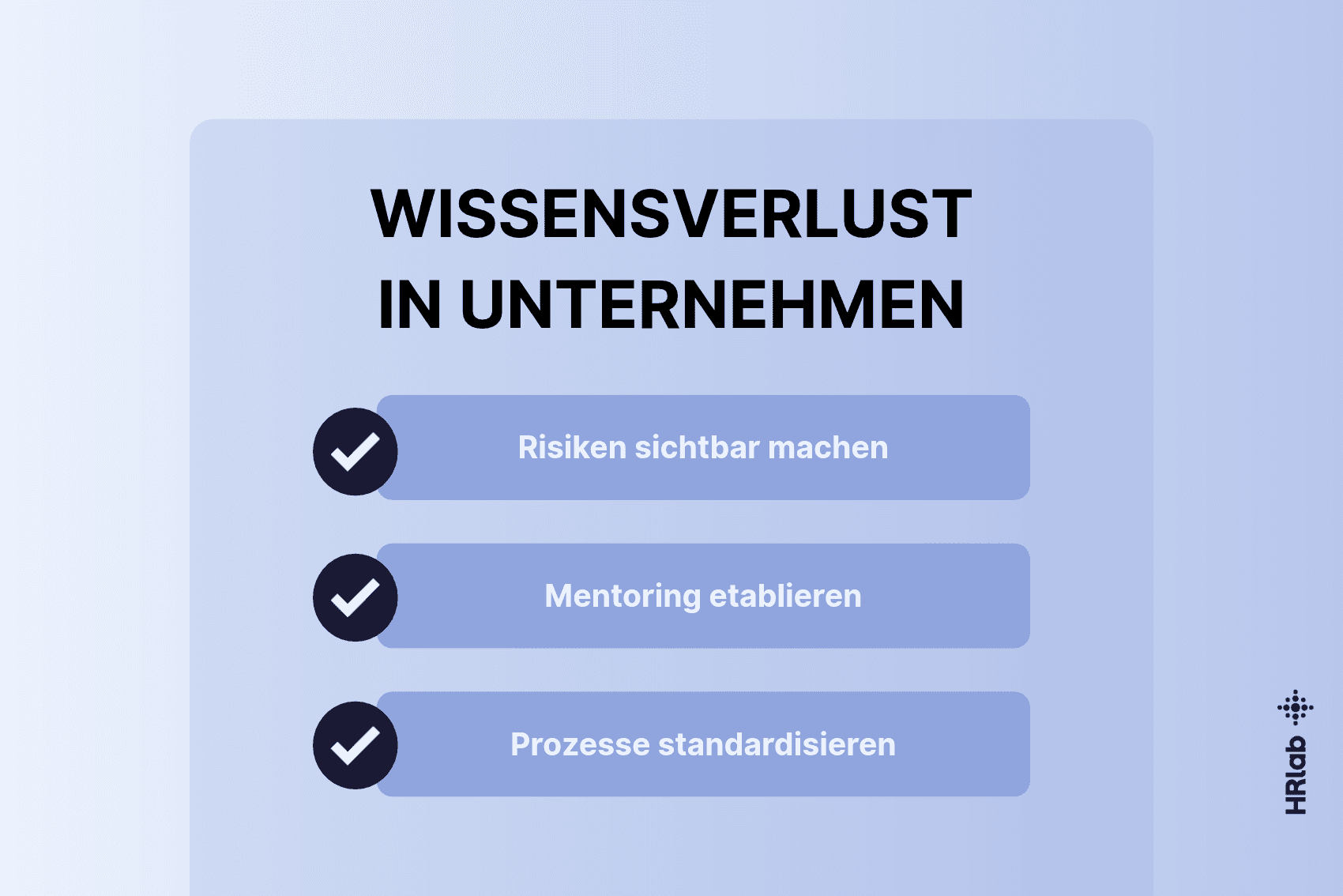
- Make Risks Visible: Identify key staff members with deep expertise who are approaching retirement. Which tasks currently cannot be handled by anyone else on the team?
- Establish Mentoring: Rely on cross-generational exchange. For instance, juniors and seniors can jointly manage projects over several months to transfer implicit knowledge step by step.
- Standardize Processes and Workflows: Convert workflows into structured digital formats. Regular updates, such as on the internal employee portal, ensure that information remains accessible to everyone.
How HR Software Supports Knowledge Transfer
Tracking age structures manually in Excel spreadsheets is prone to error and consumes valuable time. All-in-one HR software like HRlab helps HR teams spot risks early and systematically initiate knowledge transfers.
| Criterion | Manual Preparation (Excel & Paper) | Digital Workflow with HRlab |
|---|---|---|
| Demographic Analysis | Time-consuming, static snapshot evaluation | Automated real-time dashboards via reporting tools |
| Process Control | Decentralized, hard to track | Standardized workflows & task management |
| Skills & Coverage | Knowledge is isolated with individuals | Skill management linked to digital employee files |
Securing Knowledge as a Strategic HR Priority
Demographic shifts and the trend toward early retirement cannot be stopped. However, the associated loss of knowledge is a manageable challenge that must be taken seriously. HR teams that analyze demographic structures digitally and establish knowledge transfer early as a standard practice will shield their companies from costly mistakes and safeguard invaluable expertise for the next generation.