General HR
How to Structure Employee Appraisals with Digital Tools

Camila Antonucci
on September 30, 2025 • 4 min. reading time
Employee appraisals are among the most effective leadership tools. However, they only work with structure—and nowadays, structure is created digitally. HR software solutions automate the key steps, ensure fairness, save time, and finally make employee development measurable. How can companies best organize employee appraisals digitally?

Common Issues with Employee Appraisals
In many SMEs (Small and Medium-sized Enterprises), employee appraisals are well-established and frequently used as part of people management. At the same time, they are often an area where most processes are still analog or inconsistent. Specifically, the following problems frequently arise:
- Unsystematic Preparation: Notes are scattered, documents are missing, evaluation standards vary → conversations appear unstructured and time-consuming.
- Lack of Standardized Structure: Managers work at varying levels of detail → comparability and fairness suffer, expectations remain unclear.
- Goals Are Not Tracked: Agreements disappear into physical folders or static PDFs → development happens in an uncoordinated way, progress remains invisible.
- Insufficient Documentation & Transparency: Meeting minutes are scattered or non-existent → traceability and trust suffer, creating legal compliance risks.
- No Follow-ups: Agreements are rarely reviewed → employees experience a lack of commitment, driving down motivation and retention.
The result is uncertainty, excessive time expenditure, and outcomes that are neither comparable nor measurable. Modern companies are therefore increasingly turning to digital tools that restore employee appraisals to what they are meant to be: an effective leadership instrument.
Why Digital Appraisal Management Is Crucial for SMEs
Especially in fast-growing or high-tempo small and medium-sized businesses, time for manual follow-up is scarce. At the same time, pressure is rising across all levels:
- Employees demand transparency and growth opportunities.
- HR needs reliable, actionable data.
- Managers want clear guidelines and guardrails.
- Executive management expects trackable, manageable performance.
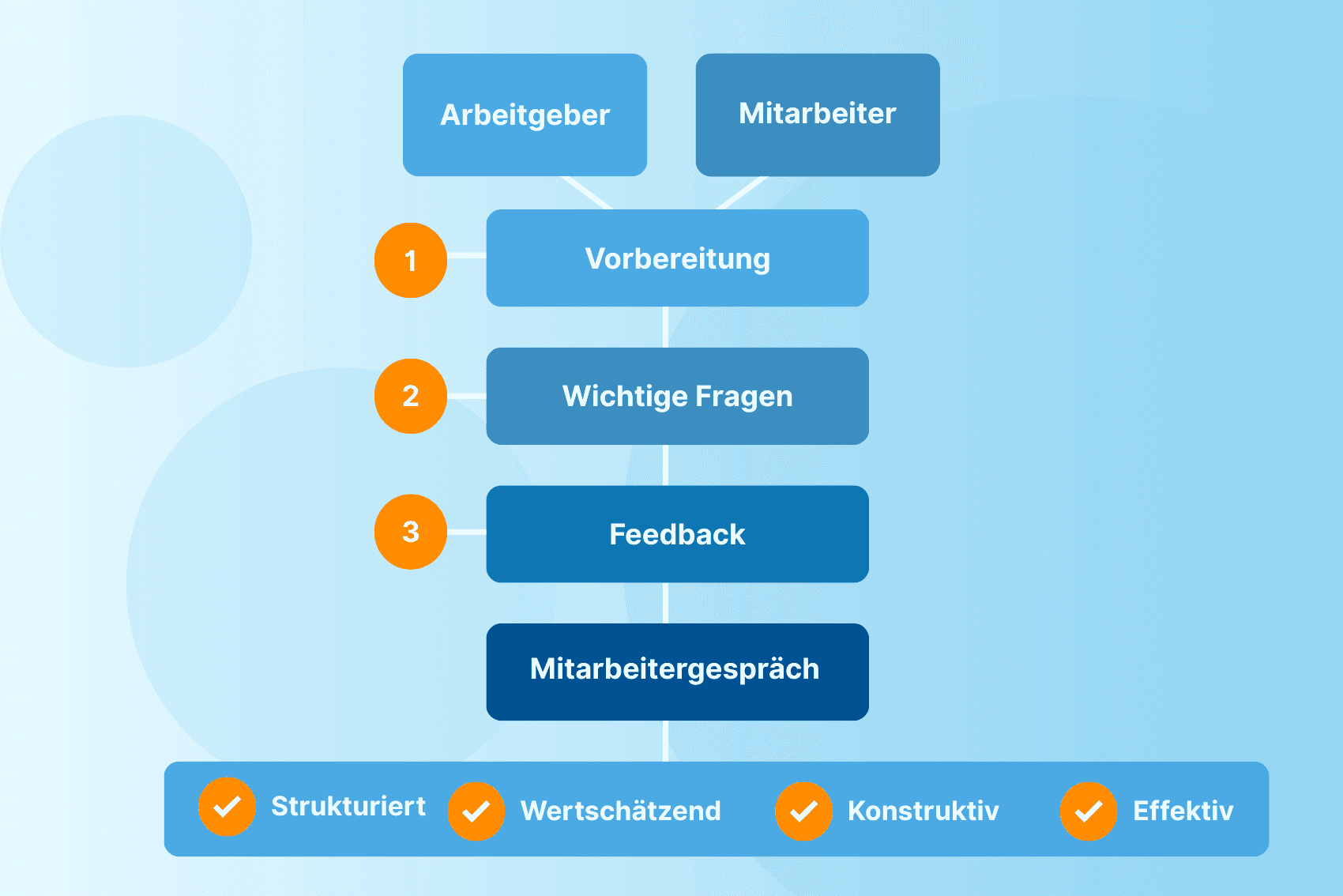
How to Digitise Employee Appraisals: The 3-Step Plan with HRlab
HRlab is an HR software solution offering comprehensive features for managing employee appraisals. These three steps illustrate how it works:
1. Standardised Preparation
Prepare every conversation using a standardised review guideline. The content of the appraisal should primarily revolve around the following key points:
- Current tasks and active projects
- Short-term and long-term goals
- Two-way feedback on delivered performance
- Growth and development potential
HR can save significant time here by using digital tools like HRlab to provide pre-built templates for different types of review conversations. This ensures that an annual review, end-of-probation appraisal, or 360-degree feedback process always follows a proven framework that can be customized as needed. This consistency guarantees that managers across different departments or locations always operate on the same foundation.
Benefits: Eliminates duplicate effort, guarantees uniform evaluation standards, and ensures efficient preparation.
2. Guiding the Conversation Digitally
The appraisal itself is where everything comes together—goals, feedback, and development. Take this opportunity to set clear, binding, and measurable performance objectives. Look beyond daily tasks to focus on long-term growth, individual strengths, and professional development wishes.
The key to efficient execution is to document everything directly in digital format. Instead of paper chaos or lost PDFs, a tool like HRlab consolidates all notes, goals, feedback items, and open to-dos in one central location—audit-proof and accessible at any time.
Benefits: All agreements are securely documented, visible, and transparent for both parties. This provides clarity for employees, reduces follow-up inquiries, and promotes workplace fairness.
OKRs for Setting Appraisal Goals
OKRs (Objectives & Key Results) are a proven framework for making performance goals transparent and measurable:
- “Objectives” define the goal itself
- “Key Results” define the measurable outcomes used to track success
- This ensures both employees and managers maintain a clear, real-time overview of progress and priorities throughout the appraisal cycle.
3. Automating Tracking & Follow-ups
An employee appraisal doesn't end with the final spoken word; its true impact begins afterward. Now, the focus shifts to ensuring that agreed-upon goals, training programs, or projects are actively executed. By utilizing digital tools like HRlab, automated reminders, progress reports, and scheduled follow-up reviews reduce administrative effort to an absolute minimum. Nothing falls through the cracks, everyone stays aligned on their current status, and the appraisal cycle seamlessly transitions back into the preparation phase for the next review—smartly supported by standardized templates, automated workflows, and measurable outcomes.
Benefits: Goals are met, agreements remain binding, and employee motivation and retention increase sustainably.